Blog

  • Hidden Ethics of Biomedical Communication on Eating Disorders

    Hidden Ethics of Biomedical Communication on Eating Disorders

    By Teresa Fang, Stentorian Editor-in-Chief

    The name “eating disorders” (EDs) may seem straightforward, but they are one of the most misunderstood conditions. The rise of attractive, accessible social media has exposed mass populations to messages conflating the ideas of body image and health. EDs impact a broad spectrum of the population and for many different reasons and ways, making recovery complex; 1 in 11 Americans—or 28.8 million people—will develop an ED in their lifetime. For young people, 13 percent of adolescents will develop an ED by the age of 20.

    Today, a general distrust of mainstream media outlets has led the public to flock to other reliable sources, leading medical sites to skyrocket in popularity and engagement. Modern readers are obsessed with personal image, and sites have adjusted and seen a drastic rise in health facts and biomedical communication. The seriousness of possible actions and repercussions has pushed objective data-driven information to subjective opinion-based suggestions, vulnerable to dishonest and dangerous arrangements to lead to misinformation, fearmongering, and competition. Thus, it is paramount that the general public becomes aware of the avenues of language a science communication piece possesses over their subjects and readers, especially with a topic so universal and nuanced yet often overlooked as eating disorders.

    Language by the writer

    To have a context for the ethical intricacy of biomedical communication when it comes to EDs, we must first look at the basic information available to the general public on the Internet. A quick Google of one of the most prevalent eating disorders, anorexia (even so, “anorexia” is an umbrella term for other EDs), will take us to the first search result by Mayo Clinic.

    Like many informational websites, this article starts with an overview of the subject but its language regresses on the verge of being a piece of scientific writing versus giving directions as if it is the widely-accepted truth. A growing subjective language used to describe anorexia, which still is a widely-debated topic to be categorized medically, effectively freezes the process of teaching anorexia to telling readers how to see anorexics, disqualifying the root issue as how to deal with the aftermath rather than deal with how anorexia is borne in the minds of anorexics in the first place. The writers of Mayo Clinic unconsciously adopt this false essentialization of all anorexics as people who have no self-control, have unrealistic perceptions of life, have fatphobia, and starve themselves for personal validation of their self-worth.

    This is not to casually accuse Mayo Clinic of scientific misrepresentation. They are among the world’s largest and most influential medical nonprofits, rated as the No. 1 hospital in the world for the past six years in the global hospital rating. In the organization’s mission and values statement, Mayo Clinic claimed that its vision is “transforming medicine to connect and cure as the global authority in the care of serious or complex disease” (Mayo Clinic); they view success as the paradigm of scientific progress and social compassion, a representation of their patients by collaboration so close to their patients the doctors can be called patients themselves. 

    Interpretations by the reader

    As seen in Figure 1, a person with anorexia may interpret the language as hypocritical or as further justification to continue their starvation behaviors to be “better” or thinner than other anorexics for more societal attention and praise. With this article and that of other biomedical communication writers from organizations such as the National Eating Disorders Association and Healthline, the lines between objectiveness and subjectiveness are easily blurred.

    At the same time, these texts gain traction on the Internet because of their authority and wide acceptance. Articles by lesser-known professionals and experts are often buried underneath higher-standing ethos, albeit they may provide the same information about eating disorders but at a level easier to digest and understand for both general audiences and people with EDs, like citizen science.

    In a 2022 blog post on Octave, a mental health care provider-based company, author TJ Mocci explains why EDs are difficult to understand, along with suggestions on how to support people struggling with an ED. The ethos of the writer as a Licensed Marriage and Family Therapist (LMFT) and the logos of the broad but niche language become a powerfully visceral tool for the blog in promoting understanding in a non-triggering way; the use of targetted facts and statistics are reminiscent of active listening strategies that make an effort to understand what the other person is trying to communicate, making them feel less alone.

    In regards to research articles that describe the latest updates/breakthroughs in producing medical cures for EDs, many articles are sourced from the Diagnostic and Statistical Manual of Mental Disorders, Fifth Edition, Text Revision, which places the majority of the symptoms of each ED on physical symptoms, remaining vague in its behavioral ones, to categorize patients. Mocci utilizes careful wording, like pronouns, and lists “common signs,” not “symptoms,” of an eating disorder to inform readers how to be good allies/supporters. These are mostly behavioral, which is less emotionally/psychologically triggering and less likely to appeal as a fairy tale weight loss story. Intentional language can address readers directly and allows for a reader with an ED to gain sympathy for third parties, who may or may not also have EDs, which in turn allows them to gain sympathy for themselves.

    Misinterpretations

    As with any piece of writing, it is impossible to avoid misinterpretations, but the writer must be especially careful when consciously choosing language and interpretation to teach science because their work is dependent upon honesty. Some articles can fulfill both obligations; Mocci’s Octave blog can both inform and generate sympathy. This article promotes a pragmatic way for individuals, families, and communities to help people with EDs recover fundamentally. Other articles may disregard language and interpretation to get their information across. The growing demand to get immediate answers at its extremes has altered people’s perceptions of honesty. Technology has superseded honesty to dangerous trust. Now, more than ever, biomedical communication must be aware of the nature of this ethic.
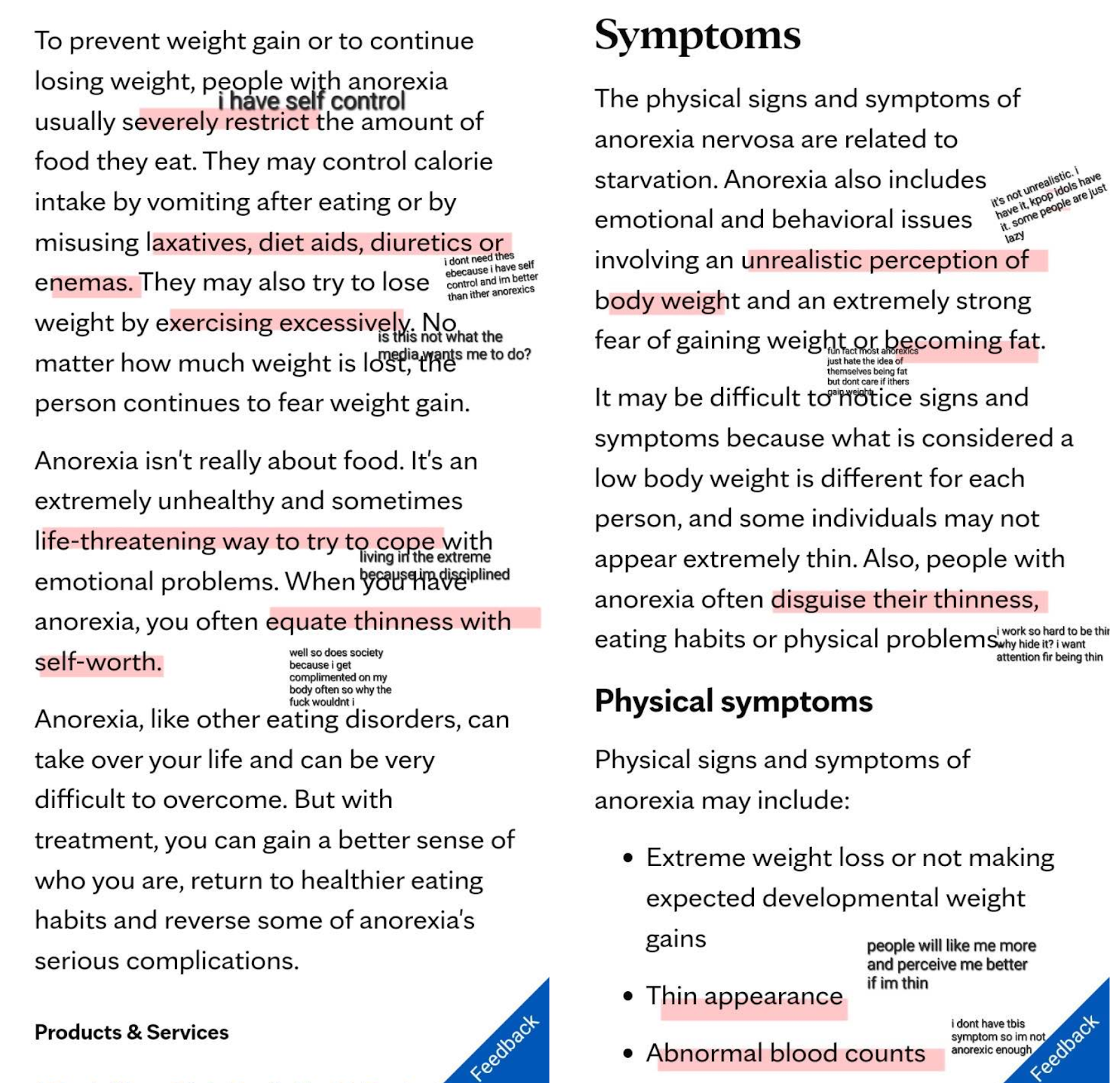
    An excerpt of Mayo Clinic’s article on Anorexia nervosa (Mayo Clinic, 2018) with annotations by a person with anorexia (Anna Tringale).
  • “Gilmore Girls” Raised Me and How it Continues To Do So Today

    “Gilmore Girls” Raised Me and How it Continues To Do So Today

    By Tejasvi Shirolkar, Guest Contributor

    (Tejasvi Shirolkar)

    Every October, I tend to grab some stovetop popcorn, snuggle up in a warm comforter, and relish in the joy of watching my comfort show: “Gilmore Girls.” As a devout viewer of the 2000’s based show, I recently restarted Season 1 and watched up to Season 4 over Fall Break. Not only does “Gilmore Girls” hold and teach valuable lessons about resilience, perseverance, and hardship, but the more I watched the show, the more I realized how much it mirrored my own life at NCSSM. 

    Disclaimer: this article only discusses Seasons 1-4, which is what I felt was relevant to my experience as an NCSSM student.

    Season 1

    Season 1 starts by introducing the main characters in “Gilmore Girls”: Lorelai and Rory Gilmore. Lorelai, a 32-year-old at the time, had her daughter Rory at just sixteen years old. The clash between Lorelai and her parents, Emily and Richard, is seen early on in the season, as Lorelai goes to ask her parents for tuition money for Rory’s new acceptance into an elite private school, Chilton. 

    While I had watched “Gilmore Girls” several times, the imposter syndrome Rory experiences in Season 1 resonated with me in my latest rewatch. Coming from a large, mainly sports-oriented public high school, my experience at NCSSM so far has surfaced some of the same feelings Rory encounters in Season 1. With such talented students, Chilton and NCSSM create similar atmospheres. The self-doubt, self-criticism, and fear of failure are feelings both Rory and I have encountered at our new high schools. 

    Season 2

    Season 2reveals the messy reality of adolescence for many individuals, as Jess arrives in town. Jess, a “bad boy,” toys at Rory’s heartstrings, as she struggles to grapple the balance with Dean, her boyfriend at the time, his distaste regarding Jess, and her blooming friendship with Jess. Season 2 reminds viewers of what it means to be a teenager; making a mess and trying to balance schoolwork, family, and friends, all while finding one’s identity.

    While NCSSM students live on campus, we can share similar stories. Personally, learning to live and function at a new school while balancing keeping connections with friends and family back home has been daunting. However, after stepping on campus I soon came to realize the friendships, faculty, and staff make any heartache surrounding home worth it. 

    Season 3

    Season 3 starts off on a good note. Rory is accepted into Harvard, Yale, and Princeton University. While there is some unrest in this season when Rory decides which college to commit to, the sheer amount of joy that Season 3 brings to the show is partly the reason I keep coming back to “Gilmore Girls” every October. Later, Rory graduates from Chilton as valedictorian and presents a heartwarming and emotional speech at her ceremony that even I teared up at. Rory truly becomes the pinnacle of a Chilton student here; somebody who is motivated, fierce, and a leader.

    Every person I meet at NCSSM exemplifies those same qualities–driven, passionate and lively. Coming from a large high school, I found community in very few people. In contrast, the name itself of being an NCSSM student holds weight, and the pride I have felt to be at this school is unlike any other I have experienced before. 

    Season 4

    To preface, I would like to write that when watching Season 4 for the first time, I was utterly disappointed. Season 4 is littered with Rory’s failures–from rekindling her relationship with her [now married] ex-boyfriend to struggling to navigate her new life in college. Season 4 serves as a sharp contrast to Season 3.

    We’ve all heard it: failure is a part of life. However, based on my past month at NCSSM, I have noticed that the concept seems to be less prevalent in most students’ past lives. The last two months of being on campus have provided me with a multitude of obstacles; from managing difficult classes to deciding which extracurriculars to immerse myself into, NCSSM has been incredibly overwhelming. However, I soon realized that NCSSM is the place to fail; I will truly never have such a supportive environment to grow and learn from my mistakes.

    “Gilmore Girls” is the show that raised my childhood. I began watching as a timid sixth grader, scared of the at-the-time unknown COVID-19. Following Rory’s educational journey through Chilton was inspiring as “Gilmore Girls” gave me somebody to look up to, even if they were fictional. For this reason, whenever I see the leaves turn orange and the air become crisp, I hope the little girl inside me feels proud as I click play on a new episode.

  • Service Learning Coordinator, Mailroom, Faculty, Students Stuff Supply Truck to WNC Within 10 Days

    Service Learning Coordinator, Mailroom, Faculty, Students Stuff Supply Truck to WNC Within 10 Days

    Students volunteer with staff at the NCSSM Mailroom. (Denise Burgette)

    By Teresa Fang, Stentorian Editor-in-Chief

    Service Learning coordinator Sue Anne Lewis and Mailroom staff organize a successful Western NC Supply Drive, thanks to students who have donated and volunteered to pack supplies and teachers including Ms. Gabriela Stefan who took shifts supervising the truck. 

    The truck, a 40-foot long container on wheels, was driven to Western North Carolina by Director of Residential Education and Housing Michael Newbauer on Friday morning. This supply drive was born out of a way for NCSSM to “support our community and neighbors in need” and “send as many supplies as possible to Western NC,” Lewis wrote in a October 2 email. 

    From October 2-12, items were donated to the drive via dropping them off directly at the truck in the Bryan parking lot or shipped as packages directly to the Mailroom. More than 120 students signed up to help pack those items in cardboard boxes, labeled, then carried to the truck, contributing more than 400 total hours.

    “We repacked them to make sure baby bottles, baby formula, and the like, all went in a box and we labeled it. Batteries, first-aid kids, medicine, feminine products, stuff like that.” said Mailroom Manager Denise Burgette. “We had a lot of those. So we just took them all. The students that came over were just totally amazing.”

    During our chat, she gave me a tour of the Mailroom storage, where she showed me a box of white shipping labels ripped off from packages. She says that Lewis plans to have some students write thank you notes to the senders.

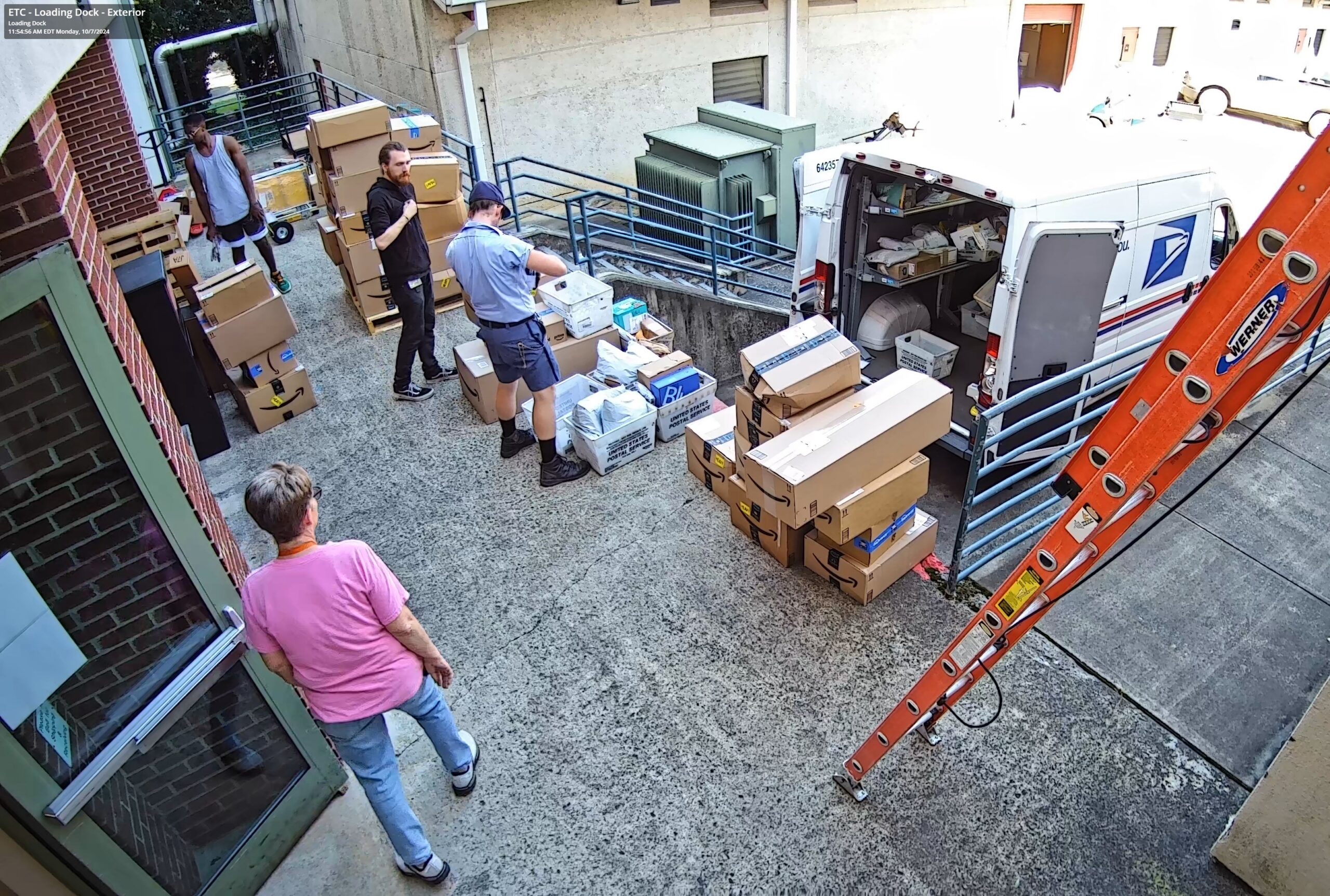
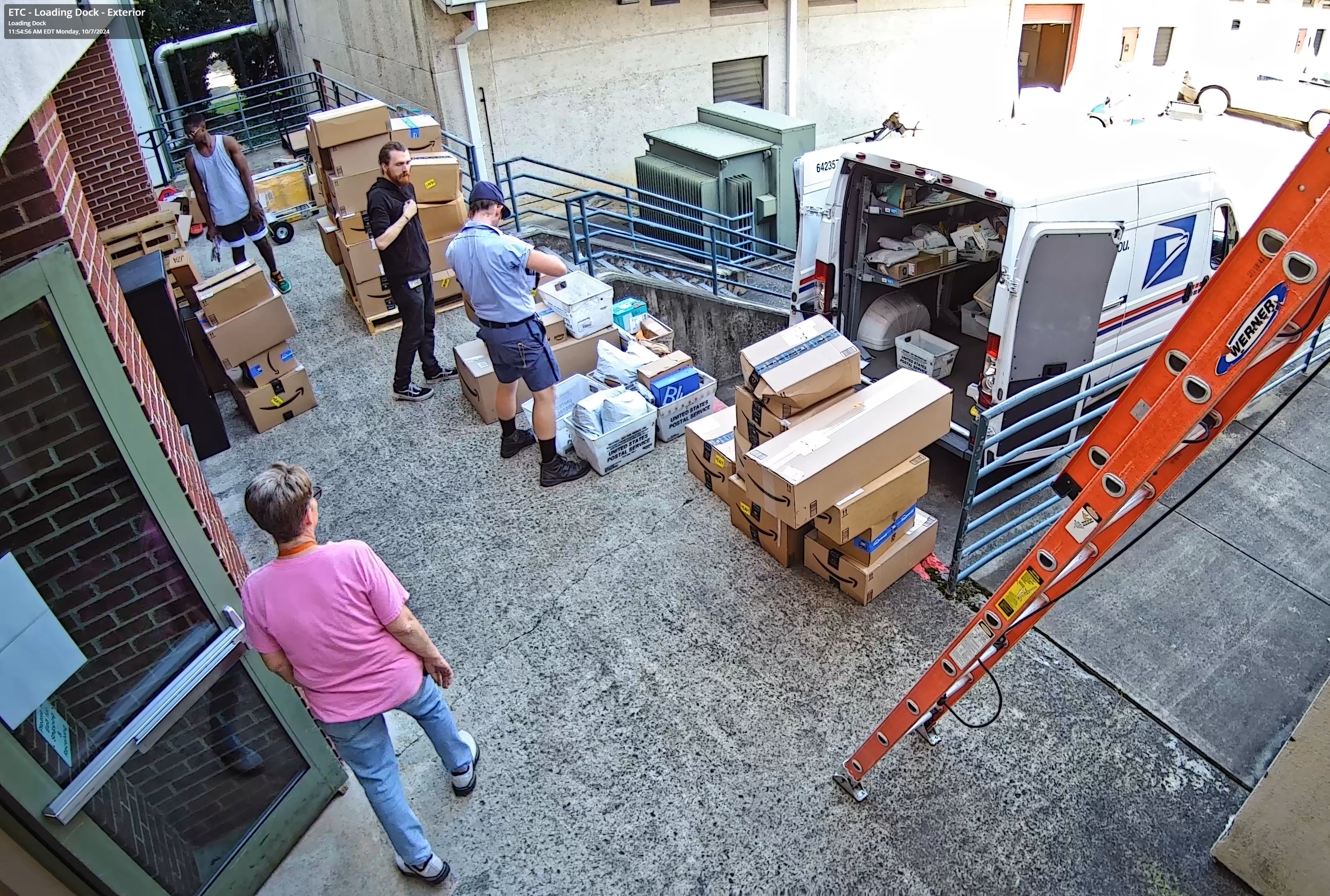
    “Within two hours, we had 372 Amazon packages.” Burgette said, describing the scene in the Mailroom on October 14. “They couldn’t fit on the shelf so we had them lined up on the dock, and there were extra tables for the students to work, breaking down packages and everything.”

    In addition to just holding the supply drive, NCSSM partnered with local Durham business Lee’s 24-Hour Towing to bring a “Stuff the Truck” semitrailer at the parking lot at Club Boulevard and Broad Street. Students were also encouraged to sign a large “NCSSM <3 Western NC” poster in the Bryan lobby and share images on social media promoting the supply drives. 

  • What’s Hiding in Hill House?

    By Viviana Gardner, Stentorian Staff Writer

    The lingering smell of sawdust in the air paired with the clattering of construction materials inside Hill House had filled my senses for the past three months. Every day, I walked past the building, my thoughts bubbling with curiosity about what lay inside the unfinished building. As my mind ran rampant with the possibilities held within Hill, I stumbled upon a theory greater than anything I had imagined.

    October 16th. The day had been particularly draining–the PSAT along with the altered schedule had thrown the student body off, going from class to class while instructors tried to drain every 25 minutes they had with us dry for education. We were tired.

    To give myself a break from the hustle and bustle of the day, I decided to give myself a short walk around the campus from the lovely comfort of the air-conditioned breezeways. Upon reaching the Greynolds tunnel to Watts, however, the air changed. The air was thin and it was alarmingly quiet. There was no ambient noise from the air-conditioning units and no scurrying of the rats in the wall. An absolute ear-deafening silence had been cast throughout that tunnel.

    A peculiar thought entered my brain at that moment, and I couldn’t help but let that thought guide my actions as I took cautious steps forward. My footsteps felt light but they were the only things I could hear as I went deeper into the tunnel and pushed my hand against the unusually heavy door to Ground Watts.

    The skull and cross-bones on the door to Hill Tunnel beckoned me forward and I was in no position to question its orders. The lights in Ground Watts were flickering, as if the power supply was running out. But that didn’t matter. Not when strange inhuman noises were bellowing from beyond the door to the Hill Tunnel. 

    Nobody had been in the area, or at least, no one was supposed to be in there; it was a restricted area and all the construction workers had been long gone. 

    Those noises only enthralled me further, and it felt like I had been walking for hours. Upon reaching my destination, a random Hill classroom, my eyes almost couldn’t believe what I had seen. Pods–hundreds of large humanoid pods molded in what appeared to be replicas of students who had been noticeably acting strange. 

    Upon further investigation, these were the same students who had let the stress of college applications get to them and fell victim to the curse of the “senior slump.” However, this was no ordinary slump. It was a disease that took over their minds rapidly and was somehow using their accumulated stress to produce an alien body double. 

    This is no satirical article. This is a call to action. Hill House is no construction zone. It is a housing unit for the aliens that have come to take over the minds of North Carolina’s best and brightest and if you’re not careful, you might be next…

  • Damage Deferred: In Photos, Videos, Emails and Petri Dishes

    Damage Deferred: In Photos, Videos, Emails and Petri Dishes

    By The Stentorian Editorial Board

    This staff editorial solely represents the majority view of The Stentorian Editorial Board. It is the product of discussions at regular Editorial Board meetings. In order to ensure the impartiality of our journalism, Stentorian editors who choose to opine and vote at these meetings are not involved in the reporting of articles on similar topics.

    Note to readers from the Editorial Board: If there are any discrepancies we missed in this story or additions you would like to make, please email us at stentoriansocials@gmail.com

    Corrections on 10/27: Greg Powell informed us that he was not forced to resign by administration. Arts instructor Carrie Alter told us that our previous mention of “band-aid solutions” was done by administration in good faith, there is no other plan to move art classes to modular units, and the temperatures are inaccurate. Those descriptions have been removed from this editorial.

    Prospective students and their families walk into Bryan lobby and read about some events in the history of the school since its transformation from the Watts Hospital: from the black-and-white photo of our three founders and the expansion of residential and online cohorts to Guinness World Records and opening Morganton.

    Warmed up to the quiet vibe of Bryan lobby at noon, their top picks from the marketplace of Wikipedia-able information, and a deluge of selective marketing from the administration, they start their tours smiling–pleased to have arrived at such a pristine and well-established school. In other words, they had finally attained thinking in the way of the institution.

    It helped that NCSSM’s public persona didn’t really open up their minds in the first place. 

    What the public don’t know are the health hazards arising from the aging and neglected campus infrastructure, which have been growing from years of deferred maintenance–a challenge made greater each day that NCSSM pushes back against calls to double down on maintenance, management, and budget needs from the students and employees who actually live here 24/7.

    In a school where, according to ncssm.edu, “Igniting innovation, cultivating community” is the tongue-twisting slogan deserving the most attention and thought, it is no wonder that people dismiss superficial meanings as anything but professional institutional values–a way to dodge questions and concerns in acts of hypocrisy, censorship, and an obsession with temporary solutions. 

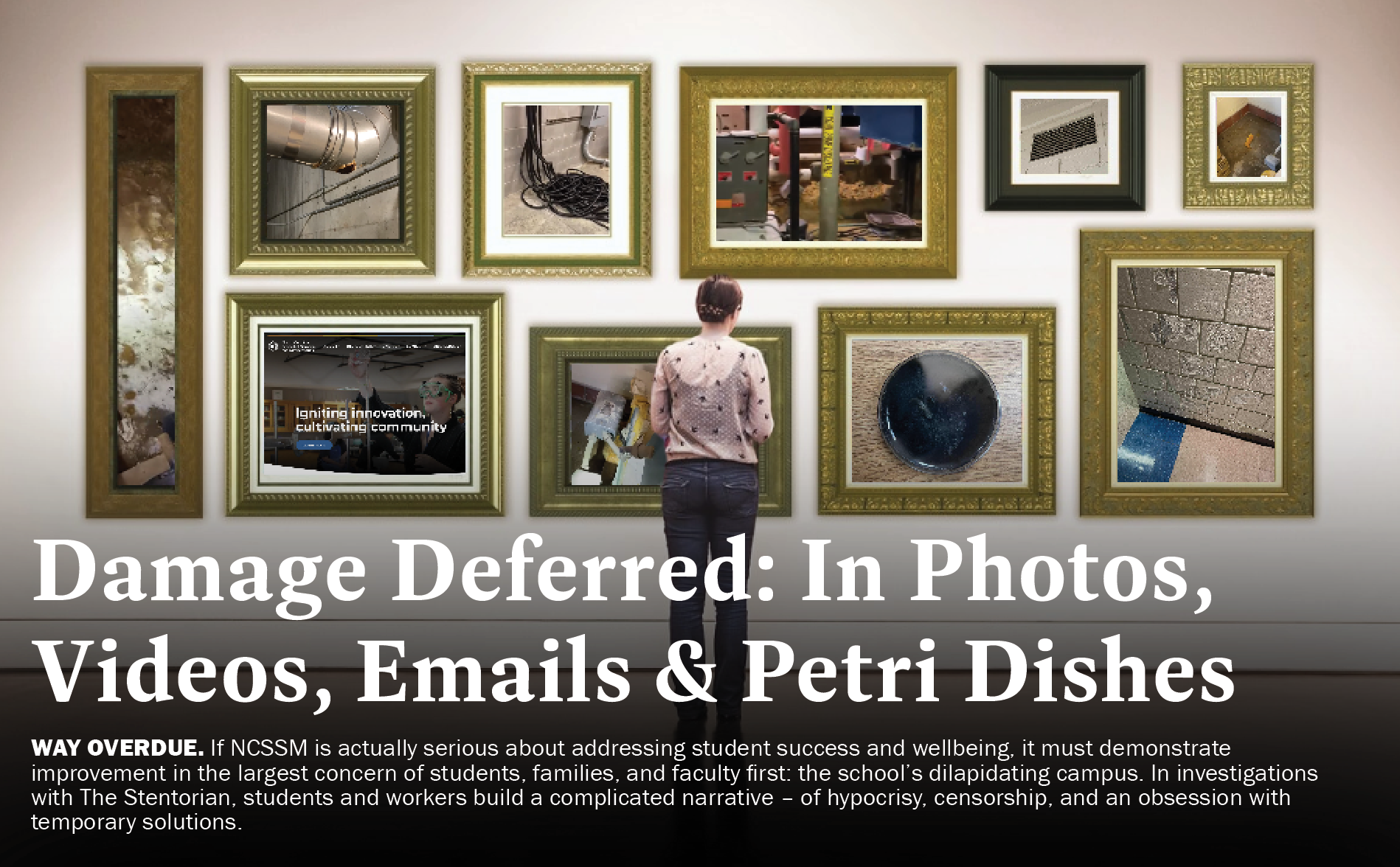
    To get a scope of the damage, we have constructed this narrative of words, emails, photos, videos, PDFs, and quotes to this article in hopes of readers grasping the severity and urgency of this issue.

    Soft & Hard Censorship

    On September 18, Carter Smith ‘25 published a post in the Parents of NCSSM Students (Past, Present, & Future) Facebook group, beginning with “Dear NCSSM Parents, Resident of Hunt have potentially been exposed to carbon monoxide, mold, fungi, and other toxic if not deadly chemicals,” followed by a redirecting to a YouTube channel (“Mech Anek”) containing video evidence of the stated health hazards. 

    When Stentorian staff spoke to Smith in a private conversation, Smith revealed he was originally going to wait to publish the post until after his meeting with the Associate Vice-Chancellor and Dean of Students Jennifer Ashe the next day. The belief that “people deserve to look at how messed up the data is for themselves” first outweighed that prerequisite. 

    “It is obviously not the parents’ responsibility to provide solutions to this issue; it is the administration’s job to ensure the safety of the students while they are at the school,” Smith said. 

    He told us he had been interested in getting to the bottom of the issue–literally, as Mech Anek’s videos show rusted-through flues leaking chemicals in Hunt’s underground and in-wall HVAC systems–since former 3rd East CC Greg Powell told Smith about concerning information on residential health and safety. 

    Since Powell joined NCSSM in March 2023, he had been increasingly voicing his concerns to the administration to fix Hunt’s frequent flooding issues, damp walls, and more. The Stentorian Editorial Board initiated multiple attempts to contact Powell for a private interview but we were unable to continue communicating after he resigned and moved off campus on September 22.

    Former electrical worker by the alias of “Mech Anek” uploaded the videos he took of various electrical and moldy places above Watts, in Hunt, outdoors, etc. to his YouTube channel. Here are three descriptions of his videos. (YouTube)

    Mech Anek had a similar story: behind the moniker was an unnamed mechanical worker contracted with the school through a third party maintenance company. He was fired in May 2024 by NCSSM for uploading the videos, the screenshots of three of his six YouTube videos provided in this article. One description reveals administration’s (“he,” referring to Vice Chancellor for Student Life and Chief Campus Officer of NCSSM-Durham, Terry Lynch) shocking response to the worker’s safety concerns of the live feed.

    “…he harassed me over pathetic hearsay. He acted as if he didn’t understand what I was telling him about the potential of the students or employees getting hurt,” Mech Anek wrote under a video published on August 22 about NCSSM’s chiller

    As another current maintenance employee (unnamed for safety reasons) described, Mech Anek was “telling too many truths and bruising too many egos.”

    “We just want to know that the students are living in a safe environment,” Smith said. “When we see these videos online and take a look at the filtres, walls, mold, and environment that students are living in, it is not unreasonable for us to have some serious concerns.”

    Hypocrisy & Denial

    Four hours after Smith’s meeting with Ashe, all residential students, faculty, and parents received an email written by Lynch, sent by Associate Vice Chancellor for Public Affairs and Chief Communications Officer Bryan Gilmer.

    As we take a look at the email’s attached report from Terracon (above), there are several issues. Two of the biggest things to consider lie within the specificity and selectiveness of sampling. Firstly, in the Limitations section: “The scope of services was limited to mold sampling as directed by the client.” Who was the client? If the school wants to not be shut down because of mold issues, then it would make sense to direct the sampling elsewhere, in a blatant act of denial of the risk already growing. And where was the danger growing?

    Secondly, in the Mold Result Summary Tables, Terracon (as directed by the “client”) tested the exterior of the art building. They did not test inside any rooms or bathrooms that may potentially have mold under tiles damaged by water or behind bubbling, peeling paint. According to the U.S. Environmental Protection Agency (EPA), mold may begin growing indoors when mold spored land on wet surfaces, and no mold grows without water or moisture. So why test for mold in the hallways and outside the buildings, when mold is prevalent where water is coming inside? Had Terracon and the client considered conducting visual assessments inside the buildings?

    Students from the Research in Biology programs have conducted this black mold testing themselves, through a more traditional but all the while more visual means: swabbing surfaces throughout campus and growing colonies in agar petri dishes. Covering both female and male residence halls, air vents, and even bathroom faucets, they note notably high quantities of black mold in Hunt and Greynolds.

    “Essentially, from the petri dishes I’ve collected school-wide, I can confidently say that there is not a single residence hall on this campus that does not show notable quantities of mold,” said Anna Tringale ‘25. They are also one of seven Sustainability Project Leaders (SPLs) at NCSSM-Durham. “Still, it’s absolutely essential to remember that just because there is mold in a room, that doesn’t necessarily mean students are at severe risk of health impacts or sickness.” 

    Some mold seemed to grow inside the agar, which is something unheard of before to Aretha Datta ‘25. “Generally, when something grows on one of our agar plates, it grows on top of the agar. But this mold had somehow gotten inside the agar,” she said. “Up close, there were small vein-like structures as well. I’m honestly not really sure what this means, but I can tell that there is clearly mold in our room, and we should be concerned.”

    The Stentorian also has firsthand experience and evidence of denial, or put differently, the lack of acceptance. On Friday, October 18, editor-in-chief Teresa Fang visited Lynch’s office and successfully scheduled an interview with him for the coming Monday, followed by an email confirmation that night. On Monday, no response from Lynch prompted her to send an email at noon with a list of six questions for him to answer via email. However, he responded as he was leaving the building that day, saying he would answer those by “tomorrow afternoon” as he didn’t have time to reply on Monday.

    The response received from Lynch was not unexpected, but instead dismissive yet equally revealing. For starters, he did not attempt to answer any of the questions provided, but provided the same information he stated earlier in Gilmer’s September 18 email. The lack of a directional response compels the Editorial Board to conclude there is also a lack of direction in demonstrating improvement for students’ success and wellbeing, two important words in the NCSSM Strategic Plan 2024-2030.

    The Stentorian also requested an interview with Ashe, but she declined to comment.

    “Students still have every right to be concerned. It’s their life, it’s their room, and even small one-time exposures can get certain individuals sick,” Tringale added.

    Obsessed With Temporary Solutions

    By now, it is clear there are many open faucets and loose ends to this narrative. One way to enter this story is through the art studio’s wall collapsing into the interior over the Summer Research and Innovation Program (SRIP) in June, due to a rainstorm’s effects on the never-renovated-before Watts Hospital walls. 

    The hole in the wall of the green screen room in the art studio on June 27, 2024, revealing the original brick wall and the materials used to insulate the room of the century-old Watts Hospital. Formerly, the art studio was an operating room where doctors carried out surgeries. (Teresa Fang)

    Likewise, the art studio’s predicament is also reflective of NCSSM’s current progress on campus “repairs”–if layers and layers of temporary solutions can be regarded as proper repair. Since last school year, the walls bleed water and white dust upon rain, human touch, or even small breezes, and one brick tile hangs precariously above the glass ceiling in the painting studio. When this school year started, rust was falling from an old gas hood and onto students’ workspaces in the advanced art studio. AR4110 Painting has already temporarily moved all their easels and paints to a meeting room in the library.

    As we have learned in EN4610 Research in Humanities, displacement does not solve any deep-rooted problems. It can position vulnerable groups of people in even more vulnerable locations. We wonder, then, what kinds of discussions our peers, parents, and teachers would be willing to incorporate into our everyday lives, classes, and our ways of thinking. Until NCSSM can express views that genuinely respond to the concerns of those most impacted and invested in student success and wellbeing at NCSSM without the fear of negatively-impacting their public persona, we strongly disagree with the methods and language used by the administration to defer campus maintenance. 

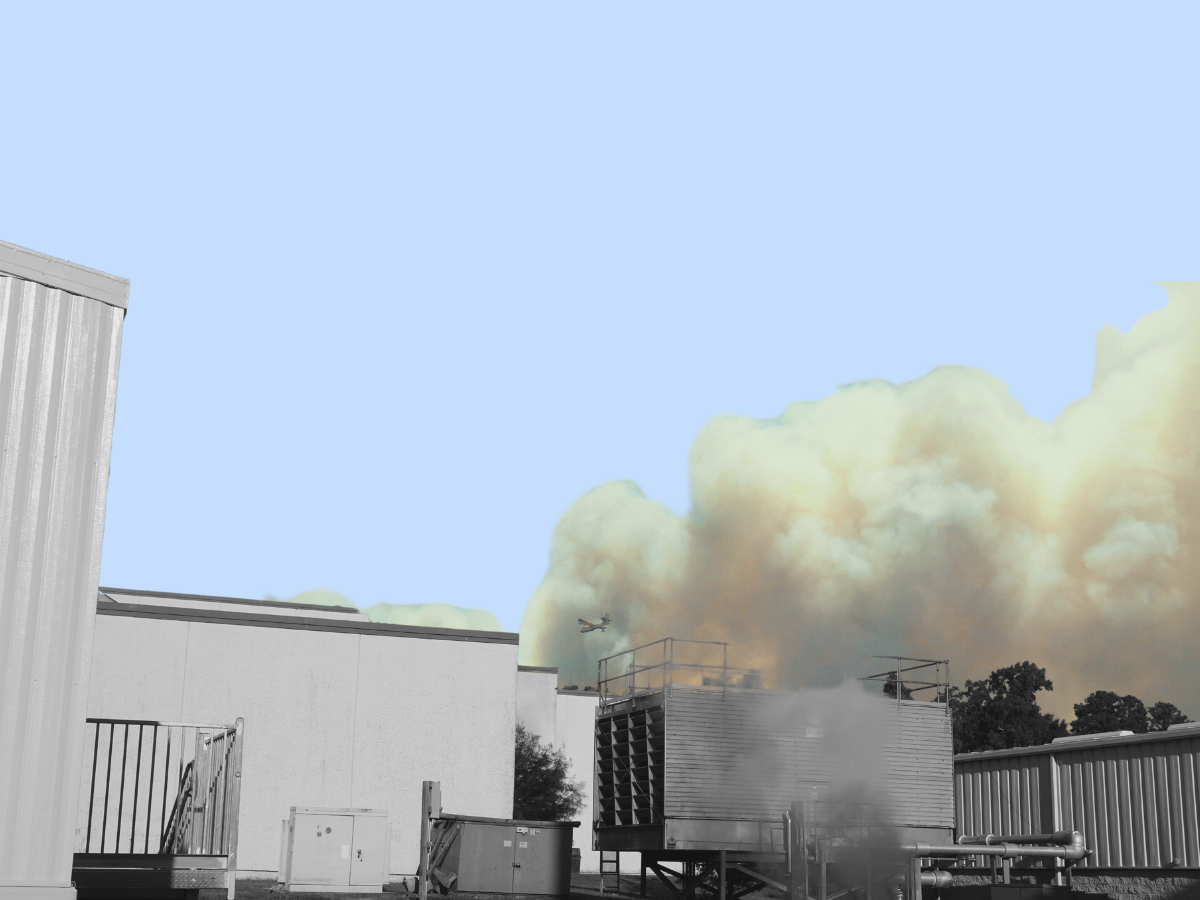
    Today, students are acutely aware that whenever there is vapor arising from the metal manholes on the ground, it indicates that a major HVAC pipe is broken and leaking natural gas somewhere. (Teresa Fang)

    If NCSSM is actually serious about addressing student success and wellbeing, it must demonstrate improvement in the largest concern of students, families, and faculty first: the school’s dilapidating campus. Until then, we worry that the future of our school will become nothing more than a moldy institution, more so than the 100-year-old Watts Hospital it used to be in the very beginning.

  • Two Years After a Damning IPCC Climate Report, Put Aside Your Attitude and Sympathy

    Two Years After a Damning IPCC Climate Report, Put Aside Your Attitude and Sympathy

    Teresa Fang.

    By Teresa Fang, Stentorian Editor-in-Chief

    In this fantasy, it’s the last day before winter break, and she’s placing her foot in the optimal position to spring up from her seat and be the first one out the door. Her eyes always big and round and beautiful reflect the words coming out of her mouth. It echoes what the crowd is saying, let’s go to the beach!

    In this fantasy, I can’t get through an afternoon drive without remembering all the things I’ve read on the billboards and graffiti on the road signs. Photographic memory. I look forward to getting home, full of the strangers who say “God bless you” on their cardboard signs at traffic signals and disappear into thin air on hot days because they’ve all appeared in our house. She’s watching on TV the latest updates of the barrier wall around New York City, and we giggle because it looks like a scene from that anime with the titans.

    In this one, the ground trembles and that’s the signal that another glacier has been dethroned, and she looks at me with fear and confusion; I meet her with the same. We must check on our sand castles before the sea swallows them forever.

    In this one, we catch picnics at the park in the windows between droughts and tornadoes so that we don’t mess up counting the millions of freckles on our faces. She takes out the vegetarian sandwiches for us to eat, and I wrinkle my nose to protest as if my bloodline has never eaten vegetables before. They’re wrapped in yellow paper, but under this sun it looks black.

    In this fantasy, water tastes like smoke. We live up in mountains and underground like moles, and racism doesn’t exist because we’re all red from the freezing cold or the bitter heat. I tell her I’m dying.

    —–

    We live in extraordinary times for the understanding of science. Before January 2024, I thought I was strictly a humanities student—I was content writing about how humans interact with the environment rather than conducting climate research myself. But as I dug deeper, I realized thatlearning about a problem was just as important as being part of the solution. And, if it’s possible to be the solution, I’d rather be the solution. So, in January 2024, I also became a STEM student, creating a climate model to predict sea level rise to help coastal communities.

    Global climate models (GCMs) are continually created or updated in the scientific world. These models are tuned and validated using the Intergovernmental Panel on Climate Change’s (IPCC) Representative Concentration Pathways (RCPs). These scenarios predict climate behavior based on projections of greenhouse gas (GHG) emissions, atmospheric concentrations, air pollutant emissions, and land use. The IPCC has ruled these scenarios for all countries from the most to the least predicted GHG emissions: RCP8.5, RCP6.0, RCP4.5, and RCP2.6.

    Where are we now? In 2022, the IPCC released a report based on 14,000 scientific papers from over 300 authors, stating that Earth’s temperature will reach the critical threshold of 1.5 degrees Celsius within 20 years. This report is described by U.N. Secretary-General António Guterres as an “atlas of human suffering and a damning indictment of failed climate leadership.” As of 2024, we are following the highest prediction pathway: RCP8.5. This predicts that by 2081-2100, temperatures will increase by 3.7 degrees Celsius, global sea levels will rise by 0.63 meters, and extreme weather will greatly increase.

    I won’t overwhelm you with more numbers; you can read about them in news articles and reports. You’ve likely already heard about rising sea levels, climate protests, and species extinction due to global warming and deforestation.

    Perhaps you believe every update, every statistic, and every quote you read., And, when you open the weather app on your phone and see a week of rain or above 90° temperatures, you may even shed one or two tears for our poor planet. 

    Or you may have attitude. It’s just the same thing every day! I get it!

    Or maybe you’ll join the climate protesters for a bit. Stop cutting down our trees! Or you’ll join the counter-protest. Extremely Mad Scientist! It’s So Severe, The Nerds Are Here!

    Then we’ll go back to living our lives.

    Historically, climate research has been met with skepticism and denialism. When the journal Science published a letter signed by 255 members of the US National Academy of Sciences in May 2010, it began with, “We are deeply disturbed by the recent escalation of political assaults on scientists in general and on climate scientists in particular. All citizens should understand some basic scientific facts. There is always some uncertainty associated with scientific conclusions; science never absolutely proves anything.”

    But political exposure twists the interpretation:

    2011. Presidential candidate, Mitt Romney. “We don’t know what’s causing climate change, and the idea of spending trillions and trillions of dollars to try and reduce CO2 emissions is not the right course for us.”

    2015. US Senator Ted Cruz. “Any good scientist questions all science. If you show me a scientist who stops questioning science, I’ll show you someone who isn’t a scientist.”

    2016. Donald Trump wanted to eliminate all climate research done by NASA. “Mr. Trump’s decisions will be based upon solid science, not politicized science,” said his top NASA adviser Bob Walker.

    2024 is still the same. “Can you imagine, this guy says global warming is the greatest threat to our country?” Trump referred to President Joe Biden at a rally in June, which had the hottest June in recorded history across the globe. “Global warming is fine. In fact, I heard it was going to be very warm today. It’s fine.”

    Now, the problem isn’t simply misinformation and believability about climate science. Yes, science produces findings that reveal something true (or close to true) about nature based on evidence. But what we need the general public to know is not a better understanding of those findings, but a better understanding of what makes those findings distinctive. 

    Some believe the philosophy of science is based on the idea that the “scientific method,” if rigorously applied, always produces good science. Twentieth-century philosopher Karl Popper warned against this, citing the problem of demarcation: a theory can’t be correct unless it can be proven wrong. In other words, it might be that people don’t believe in climate change because they don’t recognize its effects in their daily lives.

     Conducting research is not something that anybody can jump into and do, but it was through experiencing research firsthand that I knew the severity of climate change. My classmates, who are also conducting climate research, now know that. We are lucky to have the resources and opportunity to do that. 

    We can’t pretend that our efforts won’t be heard because we’re just one person.  I can’t “solve” climate change,” and neither can a whole country. But I can recognize the differences in my life that climate change is making, and I am not comfortably numb enough to sit still and live with what I don’t like. At its core, what makes science distinctive is its purpose to make people care about things bigger than themselves. It’s not the subject or method of inquiry but the values and behavior of those engaged in it that make science matter.

  • Athlete Spotlight: Caspian Miller

    Athlete Spotlight: Caspian Miller

    By Hima Manne, Stentorian Staff Writer

    Caspian Miller.

    Hailing from Boone, right-wing striker Caspian Miller ‘25 enters his final soccer season, but with a fracture in his left foot.

    Inspired by his older brother, Miller stepped onto the soccer field 13 years ago, and never left. His young exposure to Ethiopia’s (where he lived for elementary school) rich soccer culture fueled his passion, making the sport a personal priority. Despite a heavy course load, Miller balances his commitments with ease. Unfazed by his injury, he continues to play, determined to make the most of his senior year.

    With his team’s strong winning mentality, Miller hopes to lead them to the state finals.

  • Athlete Spotlight: Lola Larsen

    Athlete Spotlight: Lola Larsen

    By Hima Manne, Stentorian Staff Writer

    Lola Larsen.

    Shorty’s Famous Hot Dogs is a favorite for local hot dog lovers, including the NCSSM Women’s Tennis Team. The team thrives thanks to the dedication of juniors, seniors, and captain Lola Larsen ‘25.

    A Winston-Salem native with over 12 years of tennis experience, Larsen enters her senior year balancing academics with her love for the sport.

    For her, tennis is a stress reliever from her academic-heavy plate as she “goes outside and gets a good hit after a long day of class.” She aims to surpass last year’s semi-finals finish and lead her team to the state finals this season.

  • Athlete Spotlight: Johnathan Strickland

    Athlete Spotlight: Johnathan Strickland

    By Preston Mullins, Stentorian Staff Writer

    Ben Strickland.

    Johnathan Strickland ‘25 is in the midst of his senior cross-country season. Cross-country means more than just running for him.

    “Cross-country isn’t just about the races. It’s about conversations with your best friend during Saturday long runs, feelings of accomplishment after a speed workout, and getting to explore this city we all now call home. I don’t love cross country because of the races, I love it because of the work it takes to get there,” he said.

    Cross-country has enriched Strickland’s life in many unique ways, as its impact on him will last a lifetime.

  • 5th Bryan Turns Into Residential Hall, Workers to Move in Over Fall Break

    5th Bryan Turns Into Residential Hall, Workers to Move in Over Fall Break

    Teresa Fang.

    By Teresa Fang, Stentorian Editor-in-Chief

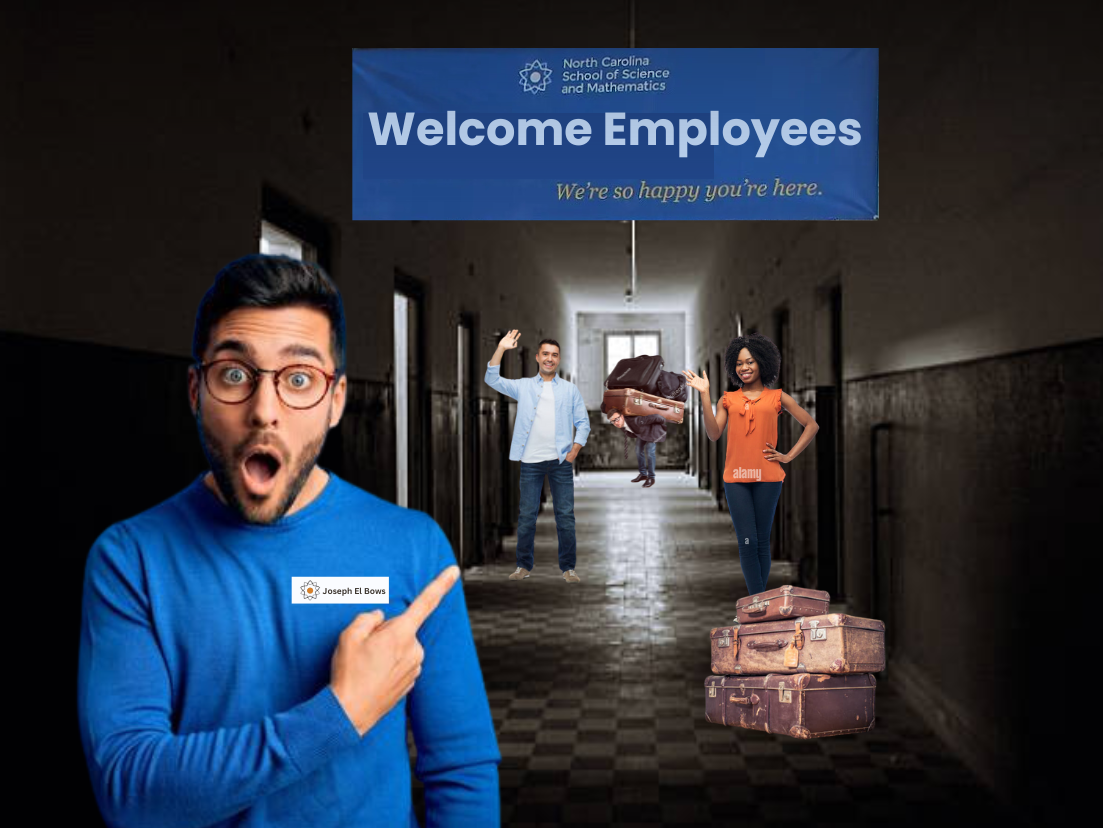
    At the conclusion of an all-employee professional development session at NCSSM-Durham last month, members of the administration unveiled news that 5th Bryan was ready for employees to move in. They reportedly chanted “we are a community” louder and louder until complaining faculty members grew tired of objecting.

    “So that’s why we bought that custom-made circular conference table?” a confused but increasingly aware employee, Joseph “Sharp” El Bows, observed. “Anyways, good riddance, because I always hated not being able to stare at everybody’s faces equally across the old square table. Oh, and I guess I’m excited to live rent-free.”

    The move will be effective over Fall Break, while students “don’t have the chance to mess stuff up” and faculty members can move in “without a hitch,” aided by all available residential staff. This will be overseen by Dean of Students Patricia Punctly, who volunteered for the position. “Rain or shine, I’ll be there. This is a great opportunity to demonstrate that the NCSSM comm-UNI-ty has immense compassion for our students going above and beyond the scope of the classroom!” she declared, chuckling at her own wordplay.

    Additionally, the 28 rooms on 5th Bryan will all be triples; an idea created by the new Director of Community Building, Wallopy Jones. 

    “I love that we’re finally seeing eye-to-eye with each other through the thick and thin,” said Jones. “In my past job, we didn’t get to live on school campus. We were always bored on the weekend! That’s why I quit.”

    Other employees share Jones’ excitement, including Community Coordinator Mary Ramsbottom, who has been at NCSSM since 1994 and was ecstatic to live closer to her teacher friends but slightly disheartened to hear she wasn’t able to room with them. Wondering why she couldn’t invoke the “Seniority Privilege,” she was quickly shut down by the administration.

    “I don’t need to share a room though, I’ve got mine right here,” Chancellor Tom Hawkins said, motioning to a hidden door on the far wall of his office, revealing a closet full of colorful sleeping bags fitting every holiday from Christmas to Tax Day. “I’m literally the chancellor of this place.”

    While this move is certainly novel in a variety of ways, the consensus among faculty is overwhelmingly positive due to the convenience of residential living and the opportunity to see the relaxed side of their students. 

    “Sweet! In all my years at Science and Math, I’ve always wanted to work on the weekends and see what my students are really like–like, what they’re really like,” said counselor Chitan Lee. “I hate seeing my seniors through grades on their transcripts. Now that’s saying something.”

    But despite the excitement of the administration, it was noted that during the professional development meeting, a fifth of the table stared at their fumbling hands in worry while imagining their work-life balance torn apart. Reporters were about to ask them for interviews before the loud chanting started and all forms of media was pushed out of the room.