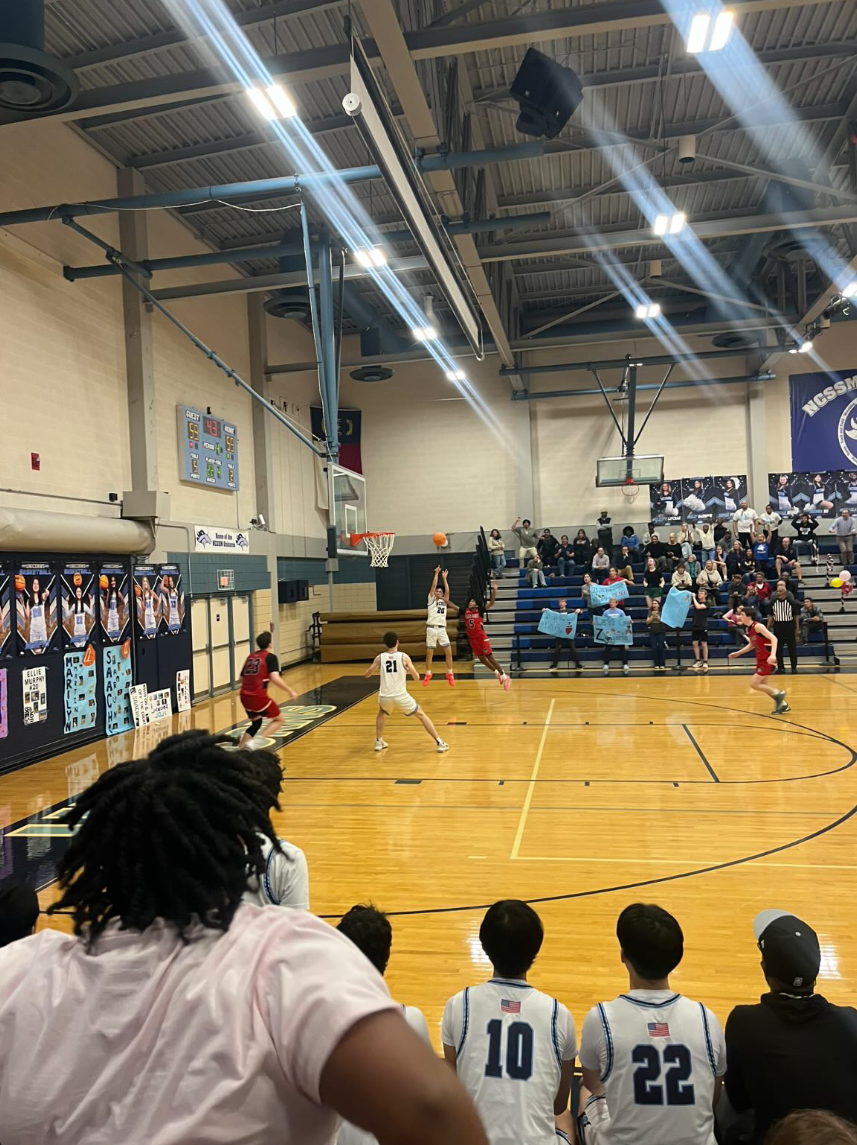
Jay Peng ’26 takes the game-winning shot. (Louisa Weinard/The Stentorian)
By Preston Mullins, Stentorian Staff Writer
There was a little extra excitement in the air on the evening of February 3rd, 2025. It was Senior night and the Class of 2025 players, managers, and cheerleaders would be recognized pregame.
As soon as the Senior night festivities wrapped up, the players turned their attention to basketball. That evening, the boy’s team faced off against the Franklin Academy Patriots; the winner would be atop the Super Six Conference standings at the end of the night. The Unis weren’t exactly favorites; they had fallen 67-53 on the road to the Patriots less than two weeks earlier. Despite this, there was a hopeful vibe emanating from the crowd. The NCSSM boys basketball team was having one of the best seasons in their history; a win here would go a long way for their hopes of qualifying for the 2A State Playoffs.
The moment of the tip-off arrived and the two teams were off and running, trading baskets back and forth. NCSSM got hot right out of the gate, and the Unis held an 18-14 lead at the end of the first quarter. As the second quarter began, the Patriots settled in and began to shift the momentum back their way.
The home crowd that had been raucously cheering just minutes earlier had quieted down significantly by halftime with Franklin Academy snatching a slim 31-29 lead at the break. There was an air of uncertainty throughout the building. The third quarter got underway and the Unis silenced the away fans as they began to regain the momentum they had earlier in the game. They brought a whole new level of energy after halftime and retook the lead 48-46 by the end of the period. This matchup was clearly going to be a nail-biter to the finish and the nervousness of the fans and students was palpable by this point.
Franklin Academy would hold a 59-57 lead with under ten seconds to play, but the Unis had the ball. Guard Ethann Burkett ‘25 was fouled with 4.5 seconds to go, which meant he would head to the free throw line to take two shots to potentially tie the game. The pressure on his shoulders was enormous, but he would calmly sink both free throws to knot things up at 59.
On the ensuing Patriot inbounds pass, the unthinkable happened. Forward Jay Peng ‘26 stole the pass and took a mid-range jumper as the seconds ticked toward zero.
Swish. The buzzer sounded; the Unis had won! The fans and players from the bench stormed the court and crowded around Jay, cheering.
What a thrilling night for Uni basketball! I got a chance to speak with Peng, as well as Burkett and Harry Gribbin ‘26, a fan who was in attendance that night.
When asked about that final shot, Peng said, “I can’t say I’ve ever practiced that shot before but as it was leaving my hands I knew it was going in. I didn’t think about it, I just let it fly. When the game ended, the feeling was surreal. As the students rushed the court, I felt on top of the world. These are the moments you dream of; it felt like a dream come true.”
When explaining how he felt as he stepped up to the free throw line, Burkett said, “I knew that I couldn’t let the doubt and nervousness overcome me. I had to step up and be confident that I would hit those shots. I shot the first one and it felt just right so I knew as soon as I shot the second one that it was going in too.”
Finally, Gribbin described his experience as a fan by saying, “It was the most exciting last minute of basketball I’ve ever witnessed. When Jay Peng stole the ball and swished the most incredible buzzer-beater I’ve ever seen, the gym erupted in cheer and we stormed the court, celebrating with the team.”
Not only did this game deliver a thrilling finish, but it was also the perfect Senior Night result and a critical shot in the arm for the Unis, who were already having an extremely successful season. Nobody entering the building that night knew what was about to transpire, but it would certainly be a game that the students and fans would never forget.
Editor’s Note: This article was initially planned to be published in October 2024.
Many will remember the shocking events of the past month involving the school’s ventilation system–the mold growth in the Hunt maintenance room. However, this isn’t the first mold incident in residential buildings; students have something to say about it.
Ellie Murphy ‘25 recounted her experience, beginning at Move-In Day. “My roommate and I had mold growing on our desk chairs, 3 ceiling tiles, our closet door, and sides of our desks,” she said. “The problems were ‘fixed’ by maintenance by spray painting over the ceiling tiles and wiping down the furniture.”
Murphy isn’t the only one whose hopes for maintenance repairs have been disappointing. Brandon Yang ‘25 expressed that Hunt has “fallen into complete disrepair”.
“I’ve gotten used to seeing problems on hall, such as our landing door failing to unlock and broken lights in our hallways, knowing that they’ll take months to get fixed despite submitting work orders,” he said.
Yang includes that he “understands minor inconveniences are bound to arise in a building that is over 30 years old” but is disappointed that the administration has chosen to ignore the mold growth in the HVAC system, prioritizing “marketing and branding.”
It’s true–NCSSM’s buildings are over 30 years old, the last modification being in 1980. Structural issues are bound to arise, and most students understand that NCSSM isn’t a new building with the latest architectural and engineering designs. The frustration is the lack of response, lack of action, and lack of improvement. Students live here for nine months–the last thing they want is to be breathing in mold, finding it on their chairs and in their clothes.
“Our room is so humid that our towels never dry and mold has grown on different personal items. When we returned from fall break, 5 or so ceiling tiles had mold growing of different colors and we put in a request for a dehumidifier to fix the issue,” Murphy stated.
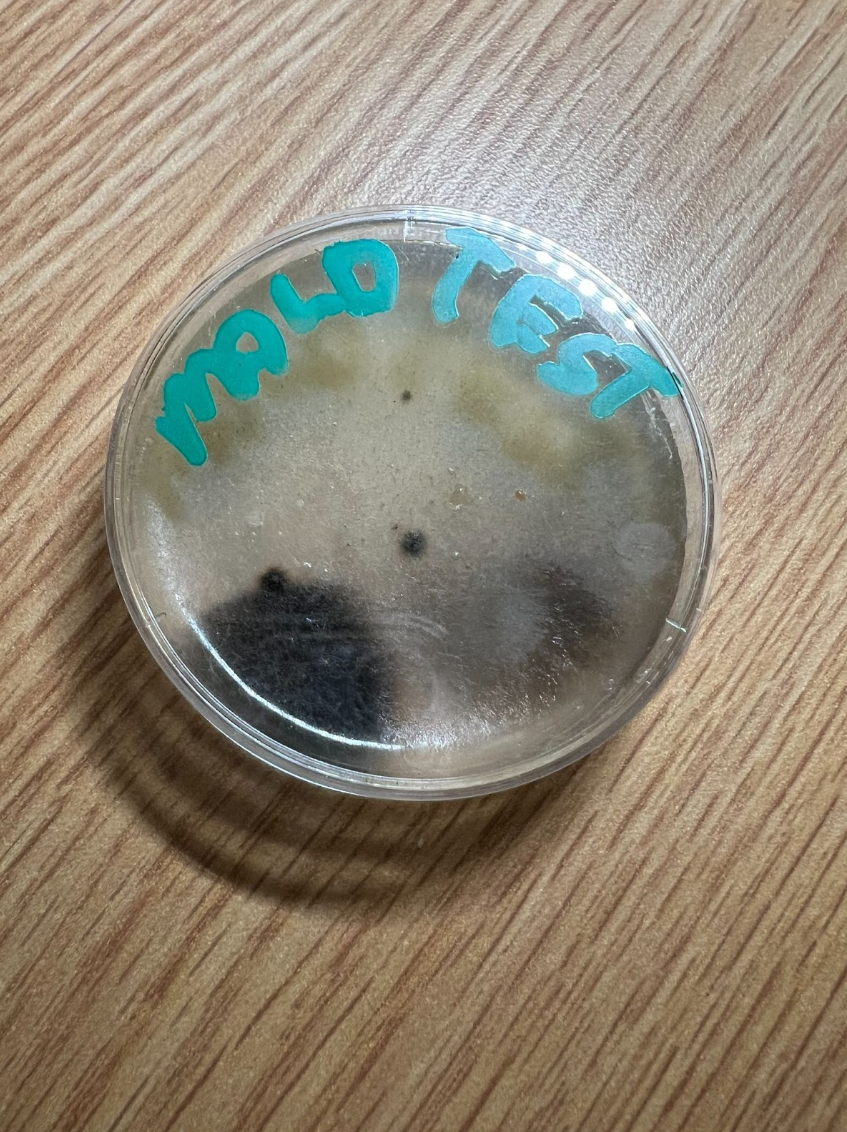
Some students have taken things into their own hands. Petri dishes and at-home mold tests were created and passed around. After the video leaked of the mold growth in Hunt, some students were determined to find out for themselves what was really going on. Cameron Shue ‘25 explained his choice to investigate.
“I obtained a petri dish from my friend and I swabbed my air vent and the chipping paint in the corner of my room,” he said. “I checked it a couple of days later after forgetting about it and the petri dish was full of black mold!”
Mold isn’t the only black substance that students have discovered. Lola Larsen, ‘25 recounts her experience with a mysterious black liquid on 1st Beall. She told me she was sitting in the hallway when “this black liquid started dripping from the ceiling”. She described it as “matte black and thick, like oil”. When she requested maintenance, they found much more in the ceiling; maintenance determined it was black water caused by mold and humidity. When asked how she felt she stated “It was a very strange and concerning experience. It makes me wonder how many years that liquid had been sitting up there for the water to turn matte black.”
Students want their voices heard and taken seriously–they want transparency and actions that show the school is truly taking in their concerns and using all their resources to find a solution. It seems that Murphy spoke the mind of the student body when she declared, “This experience has been unpleasant, to say the least.”
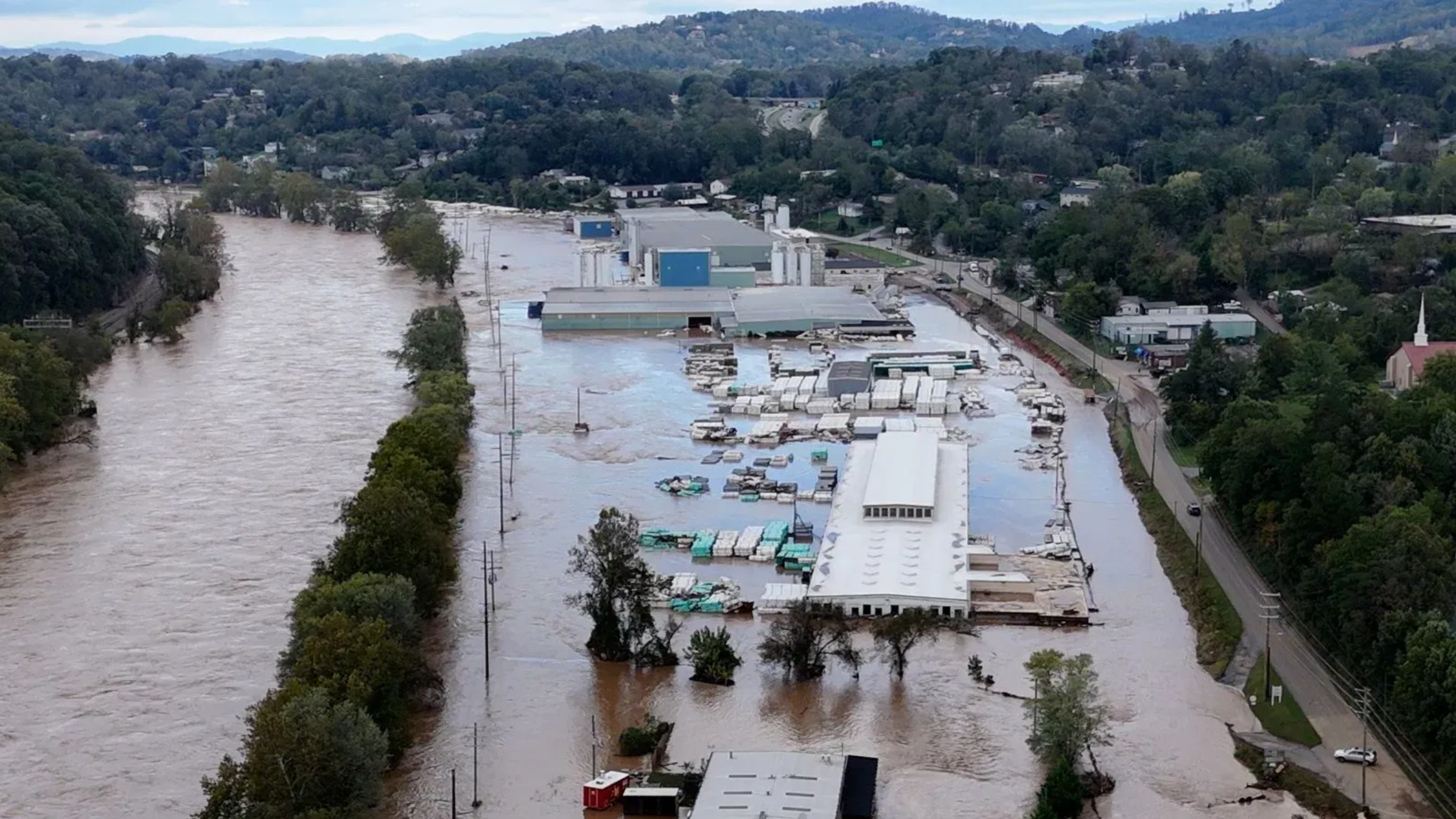
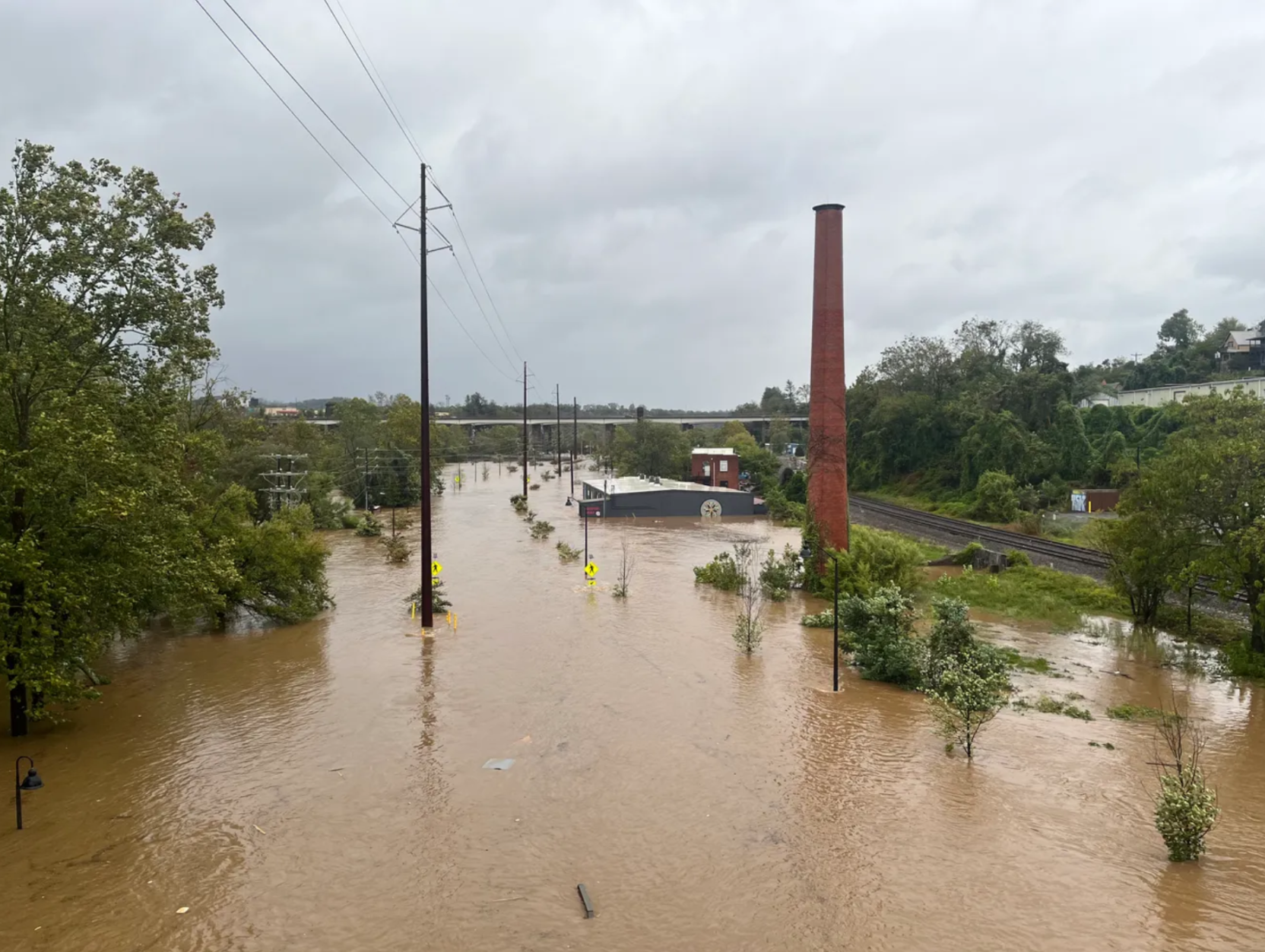
DRONE FOOTAGE ON SEPT. 28 SHOWING FLOODING AND DAMAGE IN THE ASHEVILLE AREA AFTER HELENE DUMPED RAIN AND DOWNED TREES ACROSS WESTERN NORTH CAROLINA. (WLOS 13 NEWS)
By Laela Cash, Stentorian Editor-in-Chief
Editor’s Note: This article was initially planned to be published in October 2024. Due to unprecedented circumstances, it was pushed back to be published in February 2025. The editorial board has decided to publish this article again corresponding with the print release.
On September 27, 2024, Hurricane Helene hit Western North Carolina only two days after it made landfall in Florida. The result? Record-breaking flooding and destruction that most would have thought impossible for an area roughly 500 miles away from the ocean. While not only the Western part of the state was affected, it was definitely hit the hardest.
In total, 4.5 million people lost power in a week from the hurricane with 1.5 million of those being in North Carolina, according to USA Today. On September 27 alone, there were six confirmed tornadoes across the state with one as far east as Rocky Mount according to the North Carolina State Climate Office. But that was only the beginning.
The Climate Office also reported that most Western counties got at least a foot of rain, with many reaching over two feet–effectively getting three months’ worth of precipitation in three days. Some areas including Busick, located in Yancey County, got almost three feet. Because of this, rivers including the French Broad, Watagua, Swannanoa and Catawba, almost immediately reached major flood levels and above. This nearly-submerged many towns including Asheville, Black Mountain, Boone, Morganton and Swananoa started to fill with feet of excess water.
The NASA Earth Observatory recorded that the French Broad reached a height of 24.7 feet which is a foot higher than the previous record while the Swannanoa River reached a height of 26.1 feet breaking the previous record by over six feet.
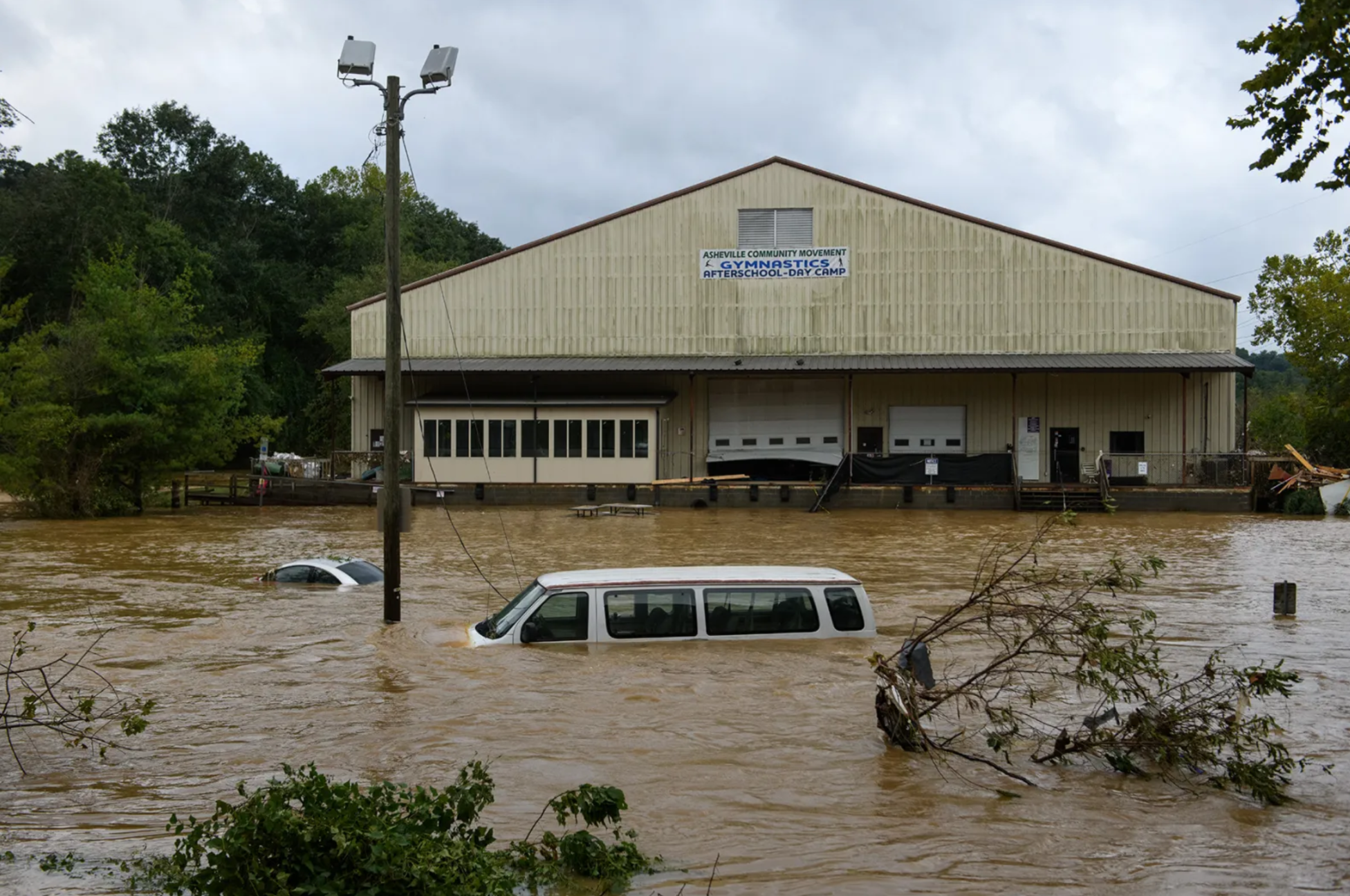
Asheville flooded rapidly as water flowed down from areas with higher elevation creating landslides along the way. Many areas became completely inaccessible almost immediately, as water breached rooftops.
At the same time, the Broad River basin was flooding, resulting in authorities attempting to evacuate areas downstream if the Lake Lure Dam broke while waves of water and debris hit the towns of Chimney Rock and Lake Lure. In total, AP News reported that the hurricane brought a total of 40 trillion gallons of water to the Southern United States.
It wasn’t only flooding that was breaking records. ECONet weather stations measured wind at a speed of 106 miles per hour on Mount Mitchell, making it the highest recorded since 2011. Similarly at Frying Pan Mountain, winds of 87 miles per hour were the highest recorded since 2004.
Such high winds inevitably led to more dangerous conditions and extreme property damage in addition to flooding. Most roads were immediately closed and travel bans were immediately put in place for the entirety of Western North Carolina. Many counties also enacted curfews to limit unnecessary traffic that may impede the travel of emergency vehicles on the remaining roads that were still accessible.
While rescue efforts started immediately, it was a long time before the full extent of the damage was realized and the timeline of recovery is still unsure. However, in the wake of this deadly storm, there has been a lot of false information spread about the aftermath. In order to understand the impact that this hurricane has had on communities in Western North Carolina and to grasp the magnitude of the crisis, it is necessary to understand the factors at play and the extremity of the events.
(MELISSA SUE GERRITS/GETTY IMAGES)
Immediate Aftermath
As the rain started to let up, the full implications of the last three days set in. In the coming days and weeks, emergency services and hundredsof volunteers worked tirelessly to rescue people. These efforts were especially difficult in remote areas that were only accessible by roads that were more or less obliterated.
According to The New York Times as of October 22, 2024, across the six states that the hurricane plowed through, more than 200 people have been killed as a direct result of the natural disaster. In North Carolina alone, the death toll is at 96 with 42 of those being from Buncombe County with 26 people who are still reportedly missing.
According to AP News, hospitals almost immediately become overwhelmed. Additionally, many were running on backup generators after the power went out and therefore had limited capabilities while some had to close completely. Mission Hospital in Asheville set up mobile units in the days after the hurricane, offering showers, handwashing stations, and free food, water, and toiletries. According to WRAL News, these tents were only possible because of federal relief and they also allowed the hospital’s staff to treat more people. This was extremely necessary as the hospital was reportedly over 200% capacity on September 27.
While some may regard property loss as more easily replaceable compared to lives, property damage is still life-changing. Governor Roy Cooper’s administration released a statement on October 23 estimating 53 billion dollars in damage.
Almost everyone who was lucky enough to still have their homes lost electricity, water, and cell service. Two weeks after the hurricane, roughly 14,000 people still did not have power in the state according to NPR. Many people, especially those in the Asheville area, went even longer, according to the city. However, Citizen Times reported as of October 18 that only 95% of that water is potable and therefore everyone is being told to boil their water. Without the internet, many people turned to Starlink as their only way to communicate with their loved ones.
Even so, many people did not have the option of getting away from these conditions, not only did they not have the resources to do so but also because the roads were destroyed in many cases, according to the Asheville Citizen Times.
(JACOB BIBA/ASHEVILLE CITIZEN TIMES)
Why Was Helene’s Impact So Surprising?
According to BBC Weather, one of the reasons that the storm’s large impact was unexpected is due to how rapidly it grew. It drew a great deal of its energy and momentum from warm waters in the Gulf of Mexico.
The local News and Observer interviewed head of N.C. State University’s Marine, Earth and Atmospheric Sciences department Gary Lackmann in order to answer this question. He stated that these waters were warmer than usual due to global warming saying that the Gulf of Mexico had a surface temperature of 86.7 degrees Fahrenheit, which is over two degrees higher than the average previous average, while the hurricane was forming. He explained that water vapor, created due to warm ocean temperatures, fuels hurricanes.
Right before the hurricane hit Florida, it quickly strengthened from Category One to Category Four in just a few days. This hurricane in particular, also had a much larger cloud cover and wind field compared to others, reported BBC. However, this does not entirely explain why the hurricane reached the usually unaffected Appalachian mountains.
Why Did Residents Not Evacuate?
One of the largest reasons is that the Western part of the state is rarely majorly affected by hurricanes.
Some people were entirely unaware that the storm was coming because they did not expect it to become so relevant to their safety. Most eyewitness and news sources say that the last time a hurricane substantially hit the Appalachian Mountains was in 2004. So, not only were many new residents unaware of this possibility, but even people who had lived through hurricane damage in 2004 would’ve believed that another would be an unlikely occurrence. This was further extenuated by the fact that the hurricane grew very quickly giving residents little time to adequately prepare or make evacuation plans.
Additionally, according to the Washington Post, disaster experts evacuation would have been extremely difficult if not impossible based on the terrain and geography especially because there are often only a few ways to get in and out of remote, mountainous areas. Also, there are no evacuation routes designated by round, blue signs like there often are in coastal communities. For that matter, there are also no flood sirens due to the general lack of flood prevention infrastructure.
Western North Carolina is known internationally for our beautiful forests and mountains, but Hurricane Helene brought devastation to ways of living and infrastructure on a scale no one could have predicted. The floods washed away not just homes and businesses, but the sense of safety and security that the mountains once offered.
Families are now left piecing together shattered lives in a place that once seemed untouched by such catastrophic storms. The road to recovery will not only be long but also a challenge as they rebuild what was lost and grapple with speculation of what factors intensified the aftermath in the first place. Yet, amidst the destruction, there is resilience—in time, the communities of Western North Carolina will rebuild as they already are working with help from the many volunteers who have stepped up to help and donations from across the country.
As someone from Western North Carolina, I urge you to do your research–this is only an overview of the full story. Everyone’s experiences are different and important. And after understanding that many people lost everything in just a few days, please help in any way that you can. We will link additional resources on our website to help you do so.
In his order directing the Pentagon to end diversity, equity and inclusion initiatives, Trump said the programs discourage merit and leadership, and discriminate on the basis of race and sex.(NPR)
By Viviana Gardner, Stentorian Staff Writer
On January 20th, 2025, the day of his inauguration, President Donald Trump enacted an executive order that sought to end “radical and wasteful government DEI programs and preferencing.”
DEI (diversity, equity, and inclusion) programs and policies have existed in many different forms since the mid-1960s when an executive order outlined that government employees were to be hired without bias toward gender, race, or religion. Since then, there have been larger strides to counterbalance the systematic discrimination that exists within our society, such as Executive Order 13985 enacted by President Joe Biden where he claimed in Ex that, “the Federal Government should pursue a comprehensive approach to advancing equity for all, including people of color and others who have been historically underserved, marginalized, and adversely affected by persistent poverty and inequality.”
On the other hand, the January 20 Executive Order, criticizes DEI programs by claiming that the programs themselves are discriminatory, as the order operates off the idea that DEI’s goal of advancing racial and gender equity was only favoring certain groups of people – ignoring the centuries of oppression and biases that still remain within societal structures and government organizations.
In implementing this order, the Office of Management and Budget (OMB), the Attorney General, and the Office of Personnel Management (OPM) have been tasked with ensuring the end of DEI programs within federal agencies while also reviewing their financial impact. This has affected countless programs and people across the nation—even in our own school, where our DEI-ties program ended and our Student Climate Opportunities, Outreach, and Programming (SCOOP) program began.
Recently, there has been an uptake in content condemning DEI and celebrating what seems to be the “end” of these programs, with many claiming them to be part of the same “woke liberal agenda” of other policies concerning ethical issues, such as those created by the Environmental, Social, and Governance (ESG).
Overall, the January 20 Executive Order has sparked debate around the existence of the policies and programs that served to make federal agencies more inclusive. In dismantling DEI programs that have allowed for a more equitable environment and that have addressed the deeply ingrained systemic inequalities, this executive order poses the risk of undoing decades of progress. As the federal government moves forward with these changes, the harm that these changes will and have caused will become a prominent topic and issue within minoritized and disadvantaged communities across the country.
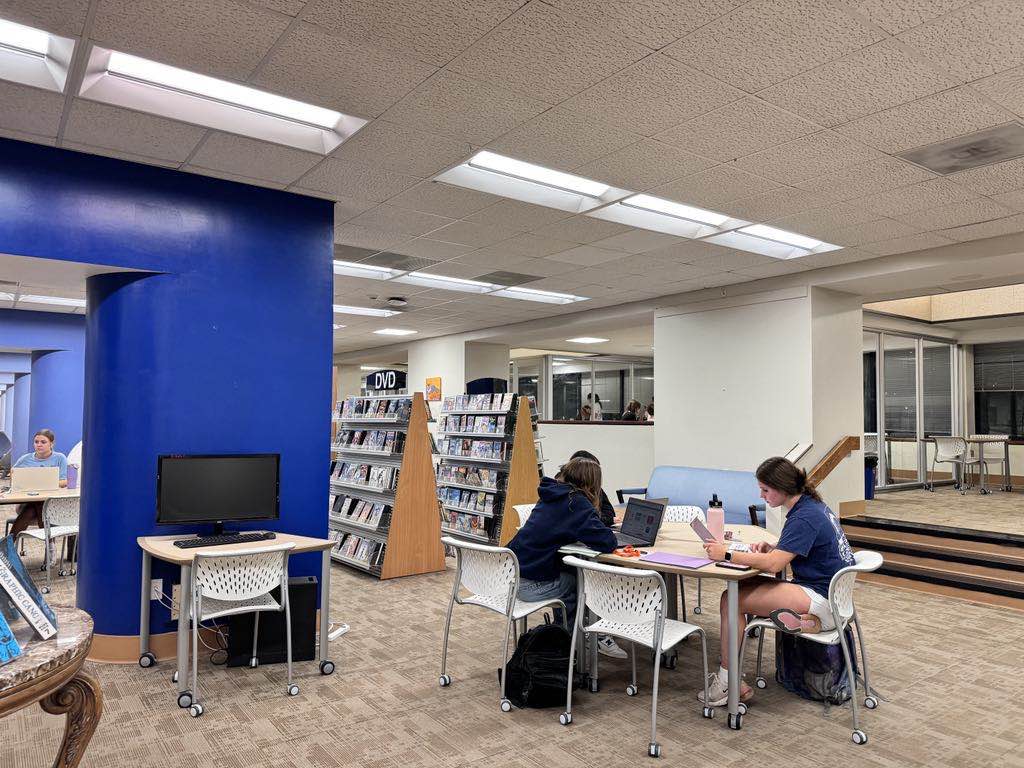
At almost any other library, one would imagine the academic environment as a reserved intellectual harbor, a collective haven for students to hone in on their work and reach an optimal state of focus. In nearly every other circumstance, libraries are equated to silent reservoirs of studying, enforced by a constant need to keep one’s voice down. From the moment one usually walks through the door comes a shift in the atmosphere, of conversations softening, the mind preparing to sharpen for the day’s load of assignments. However, at the Borden Mace Library, many NCSSM students experience quite the opposite phenomenon.
Especially at the beginning of the year, many members of the junior population have fallen victim to finding the school’s arguably loudest landscape, expecting to find a familiar space for concentration. Of all places, the scene at the Borden Mace library has ironically turned more social than studious. But how did this come to be?
Through a spatial perspective, the NCSSM website states how “the Learning Commons design of our Library creates a warm environment for interaction, inspiration, and creativity with spaces designed specifically for individuals and groups,” emphasizing the school’s importance for students to foster relationships with one another to academically succeed. The library has incorporated many openly-spaced design elements for groups of students to work together in, whether that be the multiple yellow study rooms built along the left wall of the space, or the many circular tables, some of which are embedded within the not-so-soundproof glass lounges. By incorporating friendly architectural designs to bring people together, Borden Mace has allowed positive community building to prosper–though, often with its downsides.
Because the library has majorly devoted the working space for groups of people, a lot of students are naturally inclined to hang out with their friends, leading to an avoidance of accomplishing the objective at hand: Their assignments. As one junior complains how “all of my friends are there and I can’t lock in…there’s no quiet rule”, the social restrictions of the library–or lack thereof, have allowed noise levels to get extremely high without consequences. This has contributed to the development of an unbounded gregarious workspace with little to no “work” getting done. One senior notes how “a library is a social place, not a study place”, highlighting the reality for many other students how the design features of Borden Mace have strayed far from its original purpose.
However, the bustling scene at the library is not inherently bad for those who need to finish their work. One student states, “The library is a place to socialize and interact, but it has areas where you can lock in, like the little cubbies at the sides and the quiet rooms”, showing how while much of the area has been mapped out for groups of people to collaborate (or socialize), there are still individualistic spaces for students to meaningfully their work–one just has to make sure to not overlook them, and create real action in finding a spot with less social distractions.
While strife with socialization with its people-friendly architectural features, the Borden Mace Library has not necessarily become a doomed place for studying. The flexible grounds for academic collaboration do not automatically lead to collective loss of concentration among students, but could instead allow the enhancement of it as long as one takes initiative in how to approach their work, and where to mark the line between studying and socializing.
After the grueling month that was September, while still trying to get back into the flow of neverending schoolwork, shining ahead like a golden prize was the promise of Fall Break.
This promise was gracefully fulfilled for some students of NCSSM but for others was nothing but a cruel joke in the wake of Hurricane Helene. Normally, students would fill out the fall break form, clicking the Asheville bus as their mode of transportation or would return home by getting picked up, a long commute looming overhead regardless.
On Thursday, September 26, as the hurricane steadily approached, students with homes in Western North Carolina were restless to see the effects left behind as we huddled in the Greynolds tunnel, feeling the weight of the continuous tornado warnings.
At this point, the Asheville bus was pushed back from Thursday afternoon to Friday morning because of uncertain dangerous road conditions. At this point my peers and I were overall disappointed, but grateful we still had the chance to leave. Many opted for the optimistic point of view where we got to stay overnight at our empty school, seeing it as a challenge rather than a letdown. However, this quickly shifted to the latter as the bus was delayed even further to Friday afternoon.
Many, including myself, began echoing the question, “Will we even make it back?” At this point, numerous students were not able to get into contact with their families and friends back home, unable to update them on the bus’ wavering plans of departure.
We were left behind and in the dark. Time stretched by slowly as we were on edge, unsure of our family and friends’ safety, and bound to the school’s premises which disallowed us from leaving.
For seniors, the option of college applications was available to kill time. For juniors, it was late work that needed to be completed. However, this proved to be useless as all attention and concentration was on our communities nestled in the Appalachian mountains.
According to Bella Rizzuto ’26: “Everything was up in the air. I didn’t know if my family or house was okay, at this point I hadn’t been able to get into contact with them for over a day.” Similar sentiments were echoed by the remaining students left at school.
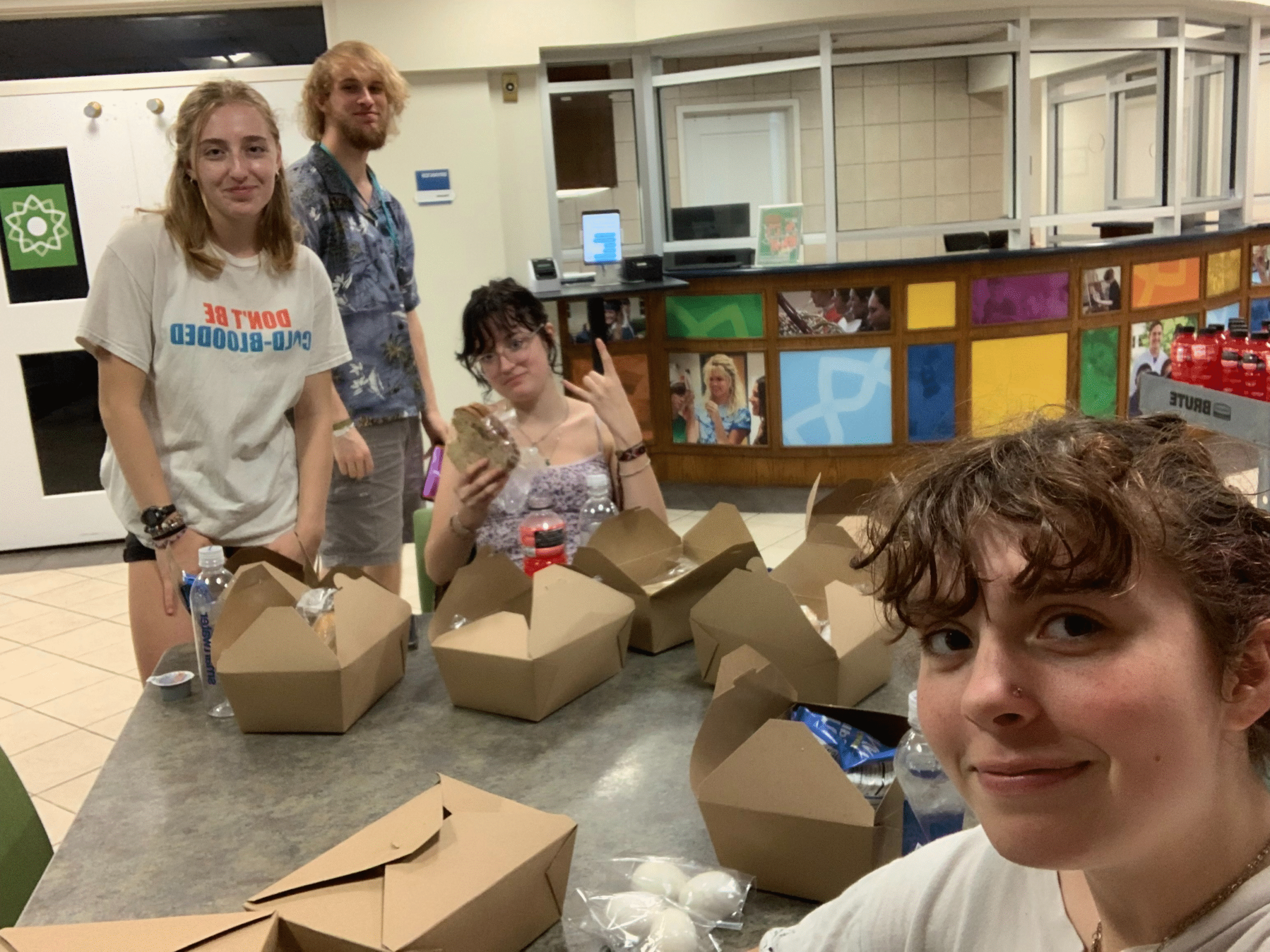
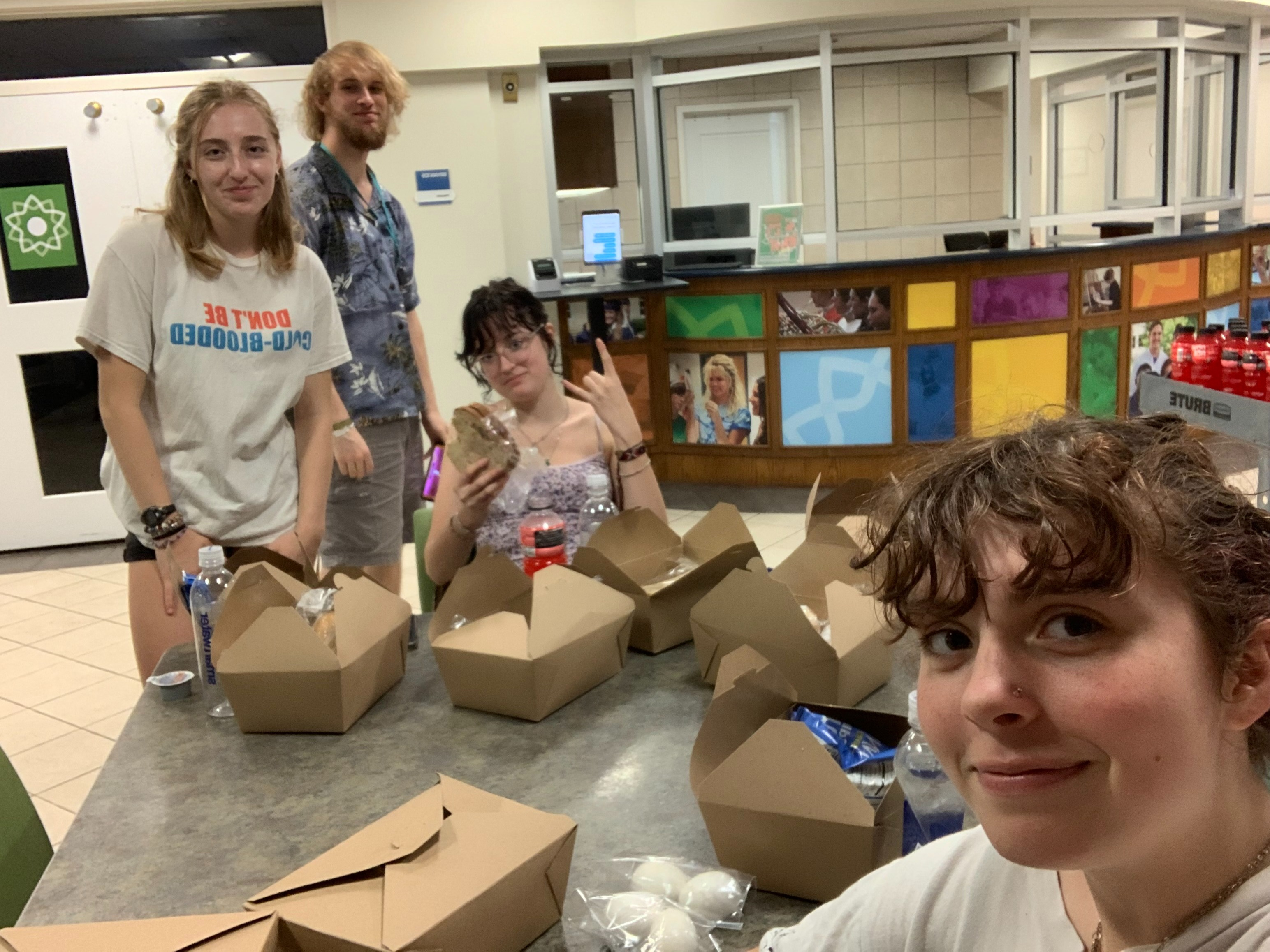
Despite the situation, the CCs and faculty came together to try and make the best out of the very apparent, bad situation. The boxed lunches and breakfasts turned into outings to get pizza at Costco and a group trip to Chancellor Todd Roberts’ hospitable home. Despite NCSSM staff being flexible and understanding, the students were still frustrated as the new update regarding the bus departing time pinged on our phones. We are unsure of when the bus will be able to depart.
Slowly, as news filtered out of the mountains we were greeted with stories of flooding, collapsed bridges, and fallen trees on buildings.
From the fifteen students delayed, it turned to twelve and later dwindled to three left, spending the entire fall break on campus, unable to return home.
Have you or a loved one recently realized that all your friends have been killed by the killer that’s been chasing you? Are you currently discovering this killer’s identity as that loved one is killed off-screen?
Then call the Final Girl Hotline, the only hotline for all your final needs! Our group of girls–who aren’t like other girls–wait around the clock to provide top-quality service to you as you mediocrely end this film!
We can provide improvised weapons like wire cords with same-day shipping. Feel like you know the killer? We can provide a convenient flashback to explain why, somehow, it is morally complicated that you must defeat them.
Our service isn’t just for your current final girl situation but for your final girl life! We can provide a convenient return to your normal life where you are not at all traumatized by seeing all your friends die, followed by a mysterious cliffhanger.
Then, if the network allows it, we can provide a sequel where your normal life is interrupted by a guy you’ve definitely killed already. We can even throw in a possessed child for a fraction of the cost!
So, if you’re a final girl, call us on your phone–that will definitely die mid-call–at 1-800-FINALGIRL!
*Please note we are not in operation on Halloween Night or Friday the 13th for the holidays.
As the spooky season comes upon us, ghouls are fueled by fall fun, pumpkin spice, and midterm stress. To keep you aware of the recent hauntings, the Unicorn Paranormal Team has put together another guide on ghosts and how to handle them.
The Book Whisperer is a ghost that can be found in all parts of campus. Said to take on the forms of various assigned readings, it softly whispers into the victims’ ears that they don’t need to do their reading and that it’s all common sense anyway. This ghost is rampant, and we have not found a 100% effective way to deal with them. The current conjecture is to throw the reading at the figure, although that has seen expensive fallbacks.
The Hill Haunted is a particularly interesting ghoul; a former S’math student who went into Haunted Hill was scared to death. Some say that an actor tripped him, and others say they buried him in the volleyball court beside Hill. All we know is he shifts the position of the ground to make unsuspecting victims trip and fall in odd places such as up the stairs. If found, fall gracefully and strike a cool pose; he will be so frustrated that his attempt failed he will retreat to his resting place.
Please keep yourself safe this Halloween, and remember: be on the lookout, and if you see something, report it to the Unicorn Paranormal Activity Team.
While many seniors are thinking of college admission, many juniors are thinking of a different type of admission: the one for research. A common question asked is should one do RSci or Research in the Humanities (RHum)? The answer is why not both, and furthermore, why not RHum?
Earlier this year, Teresa Fang ‘25 wrote an astonishing article where she emphasizes the importance of interdisciplinary academics and practice. This couldn’t be more true; the limits of research are never confined to just one field.
If one wishes to be an effective academic, one should be well versed in all their curiosity–including ones that are not traditionally considered “useful”, which is in quotes as when one says not useful they usually mean not profitable. As Fang points out, the tools humanities arm you with go beyond your humanities research and into effectively communicating, critically thinking and questioning. So, then why not research the humanities?
The common answer to this is that it’s not “useful,” but useful is not used in the sense of profit but of leverage. So here’s a sense of truth: a college will not accept you purely because you are in impressive, STEM focused academic programs.
You can do a hundred RSci programs, and still not be what they are looking for. They are looking for your curiosity. What sparks it and do you follow it? If a humanities question sparks you, follow it, and even if you have no specific question let your interest as a human lead you. The follow-through of something that captivates you, is way more impressive than something you did to put on your resume. RHum is designed to captivate and explore captivation.
Additionally, humanities research goes beyond the capabilities of science research. Certainly, there are some questions that are furthered by science, but Humanities doesn’t serve as an add-on to pick up where STEM drops off, it goes where STEM cannot. Humanities concerns itself with questions not necessarily bound by the same restrictions as STEM, not to say that humanities doesn’t come with its own complex restrictions. You are bound by human thought, records, and where you can take yourself. We can take the work of STEM and apply it, as questions of AI usage, or we can take it outside of the science sphere and expand.
Make no mistake, however, I am not arguing against the RSci programs; I do hobbyist research in math and believe that you should go where curiosity leads you. I am arguing for your serious consideration of all Research in the Humanities programs, despite the doubts rebuked above. It is an experience that strengthens the heart and skills of a researcher, and if not that is sure is a lot of fun.
Here are some of the research opportunities in the Humanities!
Research Experience in the Humanities, (REXHum)
Available to all students who have completed AmStud I, this course serves as the introduction to humanities research for all who are interested, even if you have conducted research in the past. Students learn the basic skills of research, and produce a thesis. This course is available to juniors and seniors and is a choice for a prerequisite of RHum.
Summer Research in the Humanities, (SRIPHum)This program introduces students to research inside and outside of archives, libraries, and the world. A three-week program during the summer, students get the opportunity to travel to diverse museums and research a question of their choice. The student will produce an abstract, that they will get to present to a group of peers, and at the SRIP Showcase. This is a summer experience offered to juniors via application, and can also serve as a prerequisite for RHum alternatively to REXHum.
Research in the Humanities (RHum)
This is a course taught in the fall semester surrounding your research. The course aims to encourage students to enhance their reading and writing skills while expanding their knowledge in general topics and their research questions of choice. Students will produce a full research paper and will have the chance to be published in Fifth World, the student humanities research journal of NCSSM. This course is only for seniors who have met the RHum requirements.
Luckily, for both juniors and seniors, there is still time to apply and do research! I do hope that you consider, apply, and pursue any curiosity of the humanities; it is a worthy pursuit.
The Triangle region of North Carolina has plenty of exciting options for sports fans to indulge in. Whether you want to watch the tactical showdown of a soccer match or the fast-paced action of a basketball game, a wide variety of major sports are available. This comprehensive guide will detail all of the teams that a fan can see in the Triangle area.
The Hurricanes of the National Hockey League (NHL) are the only team in the Triangle from one of the “Big Four” North American sports leagues; the NHL, Major League Baseball (MLB), National Basketball Association (NBA), and National Football League (NFL). The “Canes,” as fans call them, are consistently competitive at North America’s highest level of hockey, winning the Stanley Cup in the 2005-06 NHL season. Head over to the Lenovo Center in Raleigh for some exhilarating professional hockey!
UNC Tar Heels, Duke Blue Devils, and NC State Wolfpack
The Triangle has the unique privilege of being home to three college sports powerhouses, offering fans in the region the opportunity to experience a multitude of National Collegiate Athletics Association (NCAA) Division I athletic events from field hockey to football. All three of these schools compete in the Atlantic Coast Conference and have plenty of national championships across all of the sports they field, so you are sure to see a high level of play when attending one of these events.
North Carolina FC and North Carolina Courage are the Triangle’s respective premier professional men’s and women’s soccer clubs. They compete in The United Soccer League (USL) Championship and the National Women’s Soccer League respectively. The clubs’ home stadium at WakeMed Soccer Park is the epicenter of Triangle soccer and a great place to catch a match. Fans can take a trip over to Cary to see goals galore scored by these two excellent clubs!
The Durham Bulls are a minor league baseball team; the Triple-A affiliate of the Tampa Bay Rays. They play at Durham Bulls Athletic Park, conveniently located in downtown Durham, and games there are always exciting–a great way to see upcoming Major League Talent play before they head up to the big leagues. The Durham Bulls bring the fun of professional baseball to the Triangle!
The Carolina Mudcats are the other minor league baseball team in the Triangle, but they play three levels below the Bulls as the Milwaukee Brewers’ single-A affiliate. Mudcats games are another great professional baseball option; lower-level minor league games showcase raw talent unlike the developed players of the higher levels who are on the cusp of reaching the major leagues. The Mudcats currently play at Five County Stadium in Zebulon but will be moving to Wilson in 2026.
The large selection of sporting events in the Triangle means that there is always something new to explore at just about any time of the year. With baseball and soccer in the spring and summer, football in the fall, basketball and hockey in the winter, and more, there is never a dull moment when it comes to Triangle sports. No matter what sport you choose, you’ll surely have a great time.