Author: bg.stentorian

  • How to Newspaper from High School to College, with Sellers Hill ‘20

    How to Newspaper from High School to College, with Sellers Hill ‘20

    By Teresa Fang / May 24, 2024

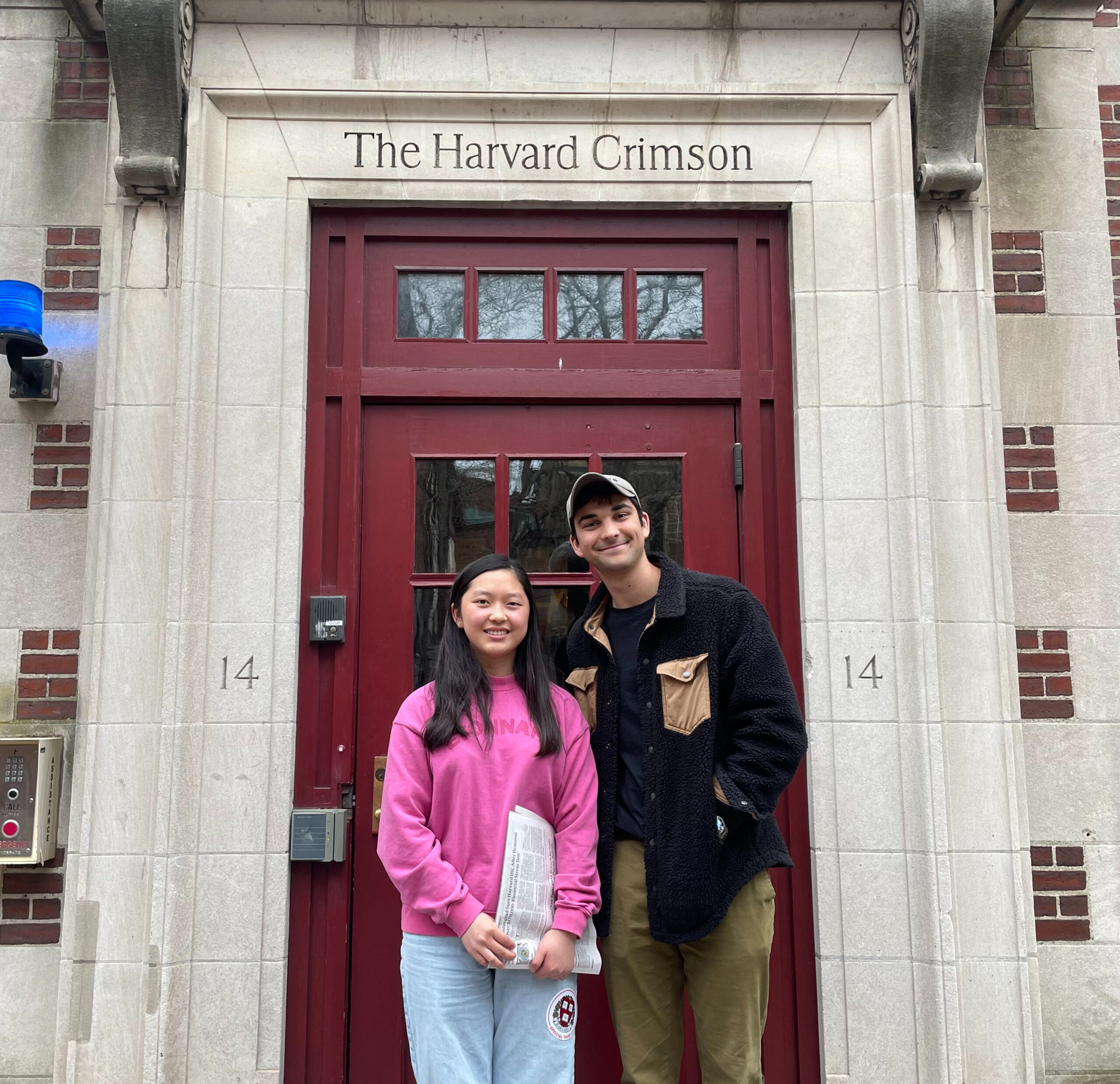
    At The Harvard Crimson building on 14 Plympton St., Sellers Hill ’20 and Teresa Fang ’25, former and upcoming editors-in-chief of The Stentorian. (Teresa Fang/The Stentorian)

    ‘20 alum Sellers Hill’s rise to the 151st president of The Harvard Crimson reflects a student journalist’s take on the student journalism world and an age of renewal. He started as an editor for The Stentorian.

    Several thousand student journalists – whether entering accidentally or not, in high school or collegiate – continue to serve their school newspapers. An unlikely base for continued journalism can arrive from unlikely places, like a STEM school called NCSSM. Although the transition from high school journalism to a college student newspaper is “certainly different,” Sellers Hill ‘20 considers his love of writing and engagement with The Harvard Crimson to his time at NCSSM.

    Journalism through The Stentorian

    Sellers Hill joined NCSSM with a goal of being an electrical or mechanical engineer but learned to maximize his time and opportunities. He eventually joined RChem, loved American Studies, became a senior senator, and taught himself how to be a journalist through The Stentorian. 

    “When I was in Science and Math, I don’t think a lot of people saw themselves as being interested in journalism. If people actually tried it, they would find that they were a lot more into it,” Hill said in an interview with The Stentorian in February. “There’s so many extracurriculars and classes that someone dedicating themselves to just one thing is not even possible.”

    As the newspaper advisor and instructor of engineering John Kirk reminisced, the 2019-2020 Stentorian editorial board Hill was a part of was the closest to staying on top of monthly publishing quotas than any other year at the present… if not for the pandemic turning the campus remote midyear. However, especially with COVID, a written record of the past remains ever important as the goal of any student newspaper.

    The Stentorian is no exception. “I think an important role of student journalism is to be a check on institutions and gauge how students are doing, feeling, and creating a record of that.” Hill said. “That’s the kind of most important role The Stentorian could have at Science and Math: the institutional memory.”

    … and advancing to The Harvard Crimson

    After arriving at Harvard College, Hill immediately joined the newspaper, where he spent the next two years writing over 100 stories as a staff writer and a reviewer for the newspaper’s readership analytics. This experience was not too different from his current responsibilities as president.

    “The job is kind of a bit of everything. You’re doing a little bit of coverage. You’re doing a little bit of editorial work. [The Crimson] is a business, and now you’re dealing with business.” Hill said. 

    In the office’s basement, The Harvard Crimson’s old printing presses stopped rolling in 2020. (Teresa Fang/The Stentorian)

    In a tour of The Crimson’s small office building hidden behind construction, he showed The Stentorian the old printing presses, which had been in use until the pandemic, with rollers still covered in ink in the 2000s-esque basement. Then, Sellers and his staff completely renewed the paper as a business. Now, they print with the help of local printing presses and are supported by external donations and advertisements.

    “Over a few months, I had to understand our revenue streams, framework for making certain business calls, certain expenses, and things like that. You just kind of get thrown into it and try to learn as quickly as you can, knowing you’re probably going to make some mistakes here and there and that’s okay.” Hill said, shrugging nonchalantly.

    Spending about 60-90 hours a week at The Crimson’s small office building hidden behind construction, Hill admits it is very hard to be a student. As an organic chemistry major, Hill has learned to adapt to a “brutal” work-life balance, but not without spending every day honing his sense of judgment in handling multiple tasks. But unlike at NCSSM, “you didn’t necessarily have to switch between multiple interests like research and journalism.” Students can do both.

    After nearly a year as president of The Crimson, Hill offered some pieces of advice for The Stentorian and NCSSM students. With any published article or controversial/conflicted topics, the relationship between the editorial board and its interviewees and readers is one of trust and clear communication.

    “When people speak to us, they know that we’re not going to turn around and say that they said something else,” Hill said. “It’s hard to get that reputation back once you’ve lost it. You have to assure your readership through years of quality journalism to show you can be trusted with things like that.”
  • Welcome Day Orients Incoming NCSSM-Durham Students to Club Fair by Classes of ’24 and ’25

    Welcome Day Orients Incoming NCSSM-Durham Students to Club Fair by Classes of ’24 and ’25

    By Teresa Fang / April 20, 2024

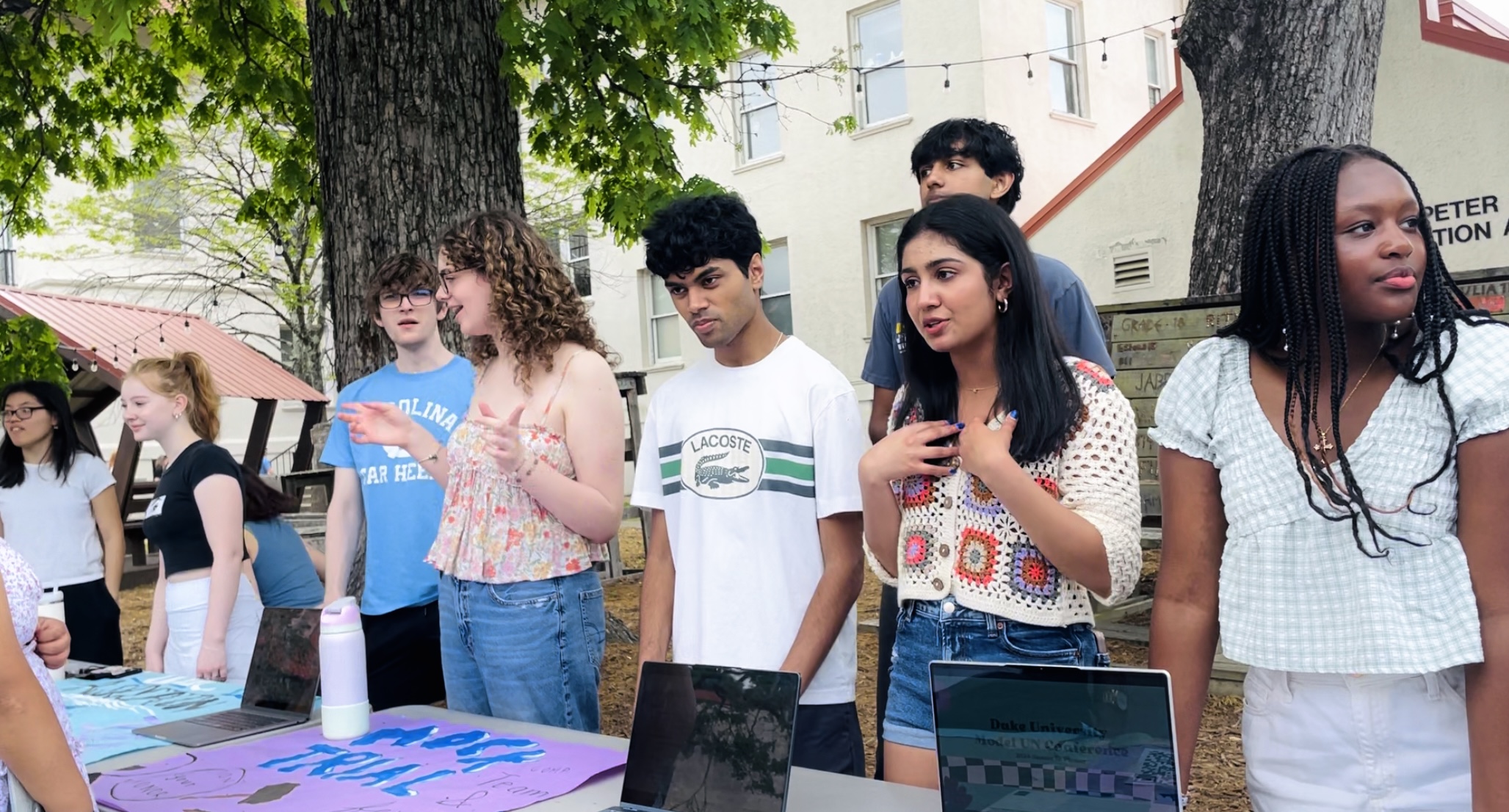
    On April 20, 2024, the North Carolina School of Science and Math hosted their annual Welcome Day to orient the incoming NCSSM-Durham students, or the class of 2026. Along with starting their flight at NCSSM in the PEC, taking photos for IDs, and dorm tours, and Students and families were invited to participate in the school’s Club Fair, in which the current students of the classes of 2024 and 2025 showcased nearly 80 student-led clubs on the Durham campus.

    Ranging from the Balkan Cultures Club to Quiz Bowl to Smath Tutors to NCSSM Rocketry and more, this club fair is the first of many fairs for the new class of 2026.

    In this broadcast, The Stentorian reporter Teresa Fang interviews students Natalie Jones ’24, Hayden Moritz ’25, Avanesh Vijayakumar ’24, and Tejasvi Shirolkar ’26 about their hopes and experiences on Welcome Day 2024.

  • NCSSM Students Ask Questions For NASA Astronaut and Class of 1997 Alumni Christina Koch

    NCSSM Students Ask Questions For NASA Astronaut and Class of 1997 Alumni Christina Koch

    By Teresa Fang / April 16, 2024

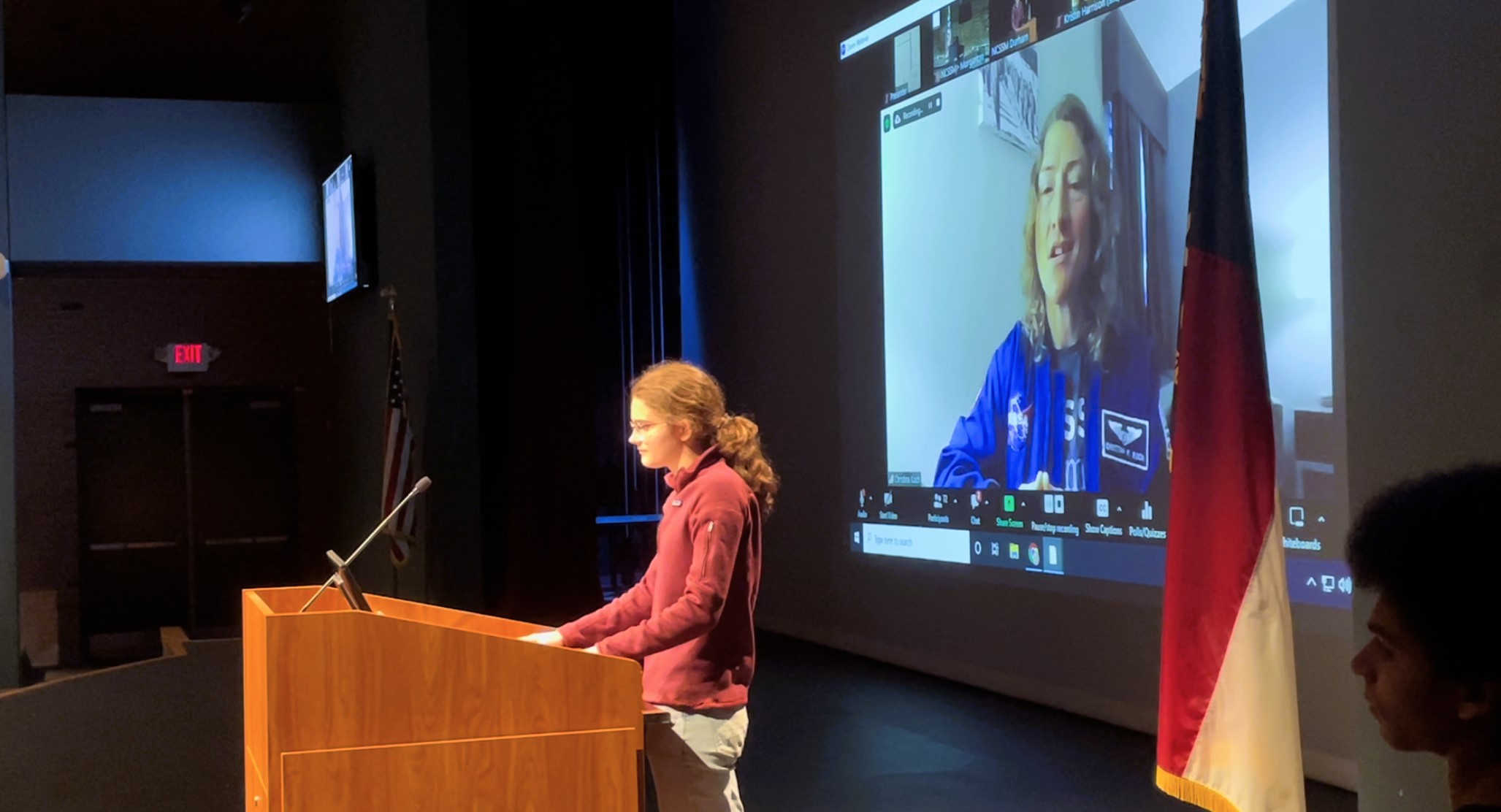
    On April 12, 2024, the North Carolina School of Science and Math hosted a schoolwide assembly, as part of the school’s Space Week event which included eclipse-viewing, to talk to NASA astronaut and Class of 1997 alumni Christina Koch.

    After setting the record for the longest single spaceflight by a woman with 328 days and participating in the first all-female spacewalk in 2019-2020, Koch is currently preparing to go to space once again as the Mission Specialist for NASA’s Artemis II mission, which will be be flying around the Moon as NASA’s first crewed flight in their long-term goal for establishing human presence on the Moon for science and exploration.

    In this broadcast, The Stentorian reporter Teresa Fang interviews students Arianna Lee ’25 and Ava Snider ’25, both students who were chosen to ask Koch questions during the assembly, and chancellor Todd Roberts.

  • Do young people still care about local politics?

    Do young people still care about local politics?

    By Teresa Fang / April 8, 2024
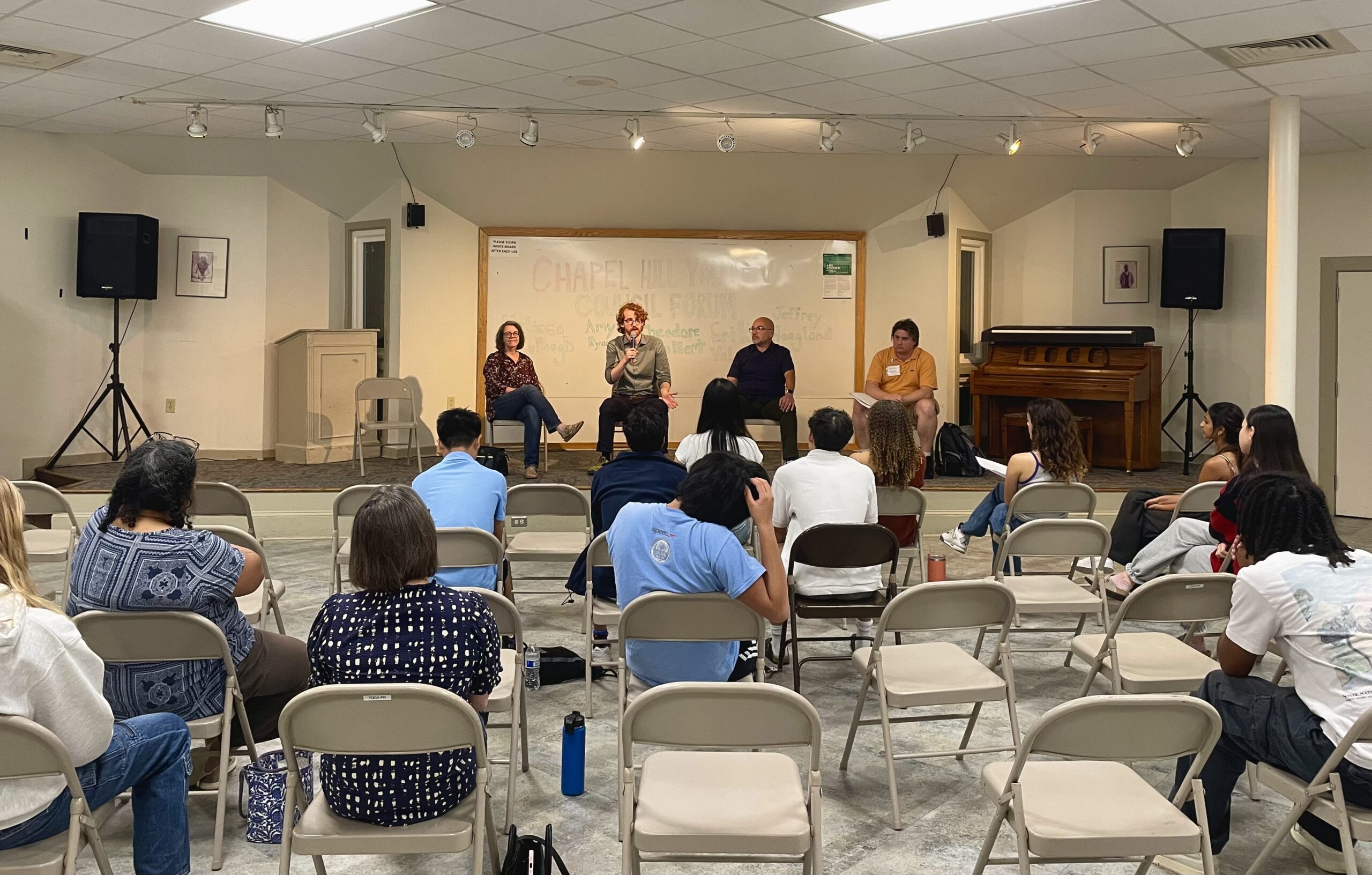
    On October 30, the Chapel Hill Youth Council hosted a forum for the mayoral and town council candidates for the then-upcoming municipal elections. (Teresa Fang/Stentorian)

    Many young people lament the polarized national politics we are set to inherit. But are we worthy of lamenting when we don’t even care about local politics first?

    I am a product of what I know as journalism and Chapel Hill civics. I worry less about the health of US democracy than I do about the deteriorating health of interest in it. Too many times have I heard a fellow high schooler voice their opinion about a recent national policy, but when confronted, they stare and cite a TikTok influencer or a popular podcaster. This response is exaggeratedly worse for local politics; local political apathy tears young people from reality and sets a precedent for misinformation.

    I single out social media as one of the largest facilitators of political apathy. A survey from Gallup reports that over half of US teens (ages 13-19) spend a minimum of four hours on social media every day. That’s four hours of being exposed to conformity influences, from beauty standards to cancel culture to the polarization of national politics. With social media becoming ever increasingly accessible, anyone can exercise their laws of free speech on social media while the consequences of spreading baseless claims become nigh invisible. 

    Anyone can complain about an issue, but can just anyone change anything about said issue? People may be knowledgeable on national politics, but if a citizen has concerns about a bus route or stormwater runoff, their representative in Congress can’t help them. But their local town council member can. If a student notices a decrease in the quality of their education at a public school, that’s just an observation supporting the recent national trend. If that student notices a difference in education at their school relative to other schools in the district, then that’s a different story. 

    Local politics impacts day-to-day lives. If young people can change our nation’s future, why don’t we try paying closer attention to our town first?

  • Zebracorns Restrategize for FIRST North Carolina District State Championship // Day 2

    Zebracorns Restrategize for FIRST North Carolina District State Championship // Day 2

    By Teresa Fang / April 7, 2024

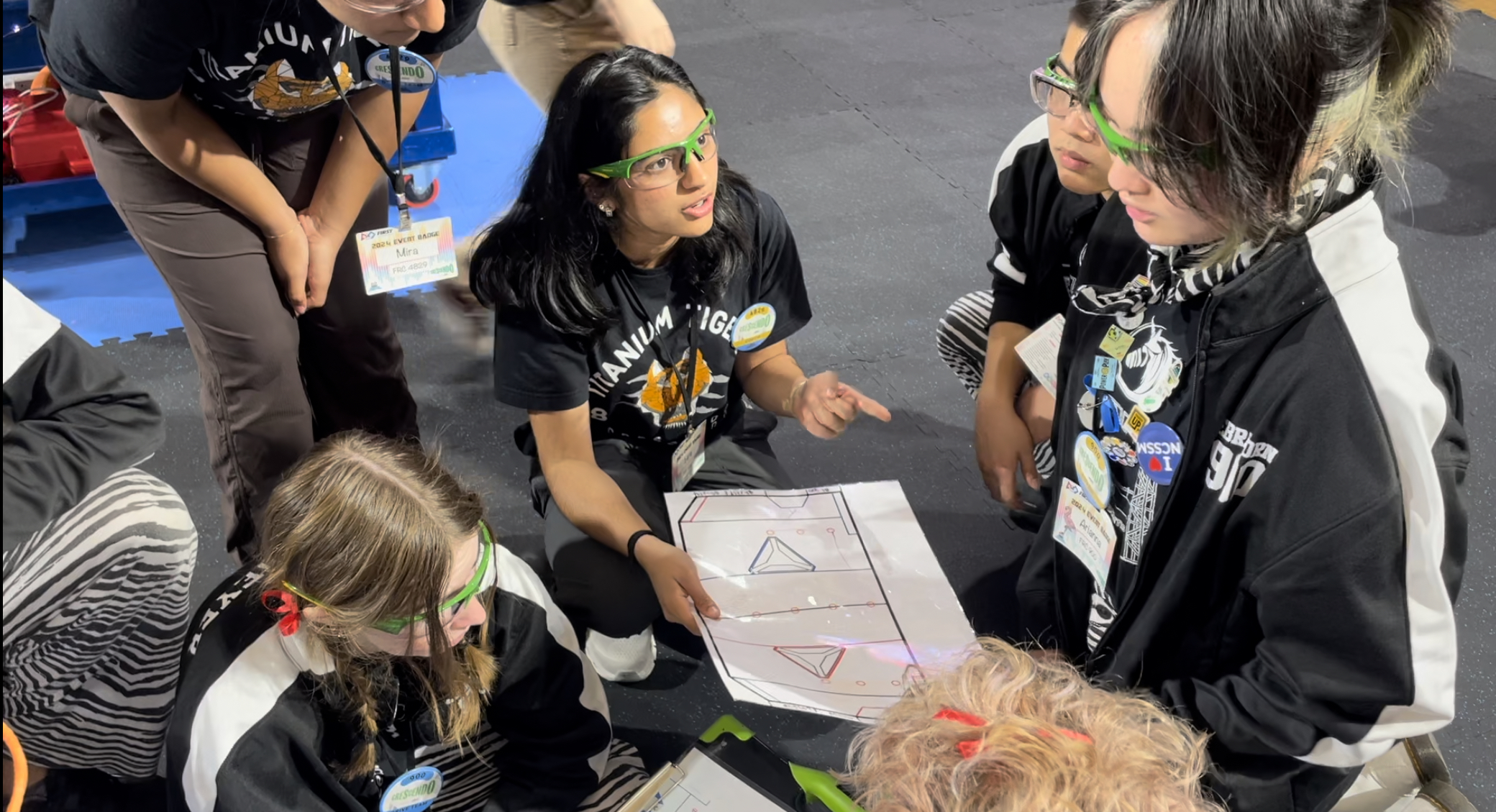
    Continuing the FIRST North Carolina District State Championship, held at the East Carolina University, on April 6, 2024, the Zebracorns Team 900 update their strategies, robot, and programming to get rid of small issues that could happen as the team competes to see who would qualify for the Worlds Championship in Houston, TX.

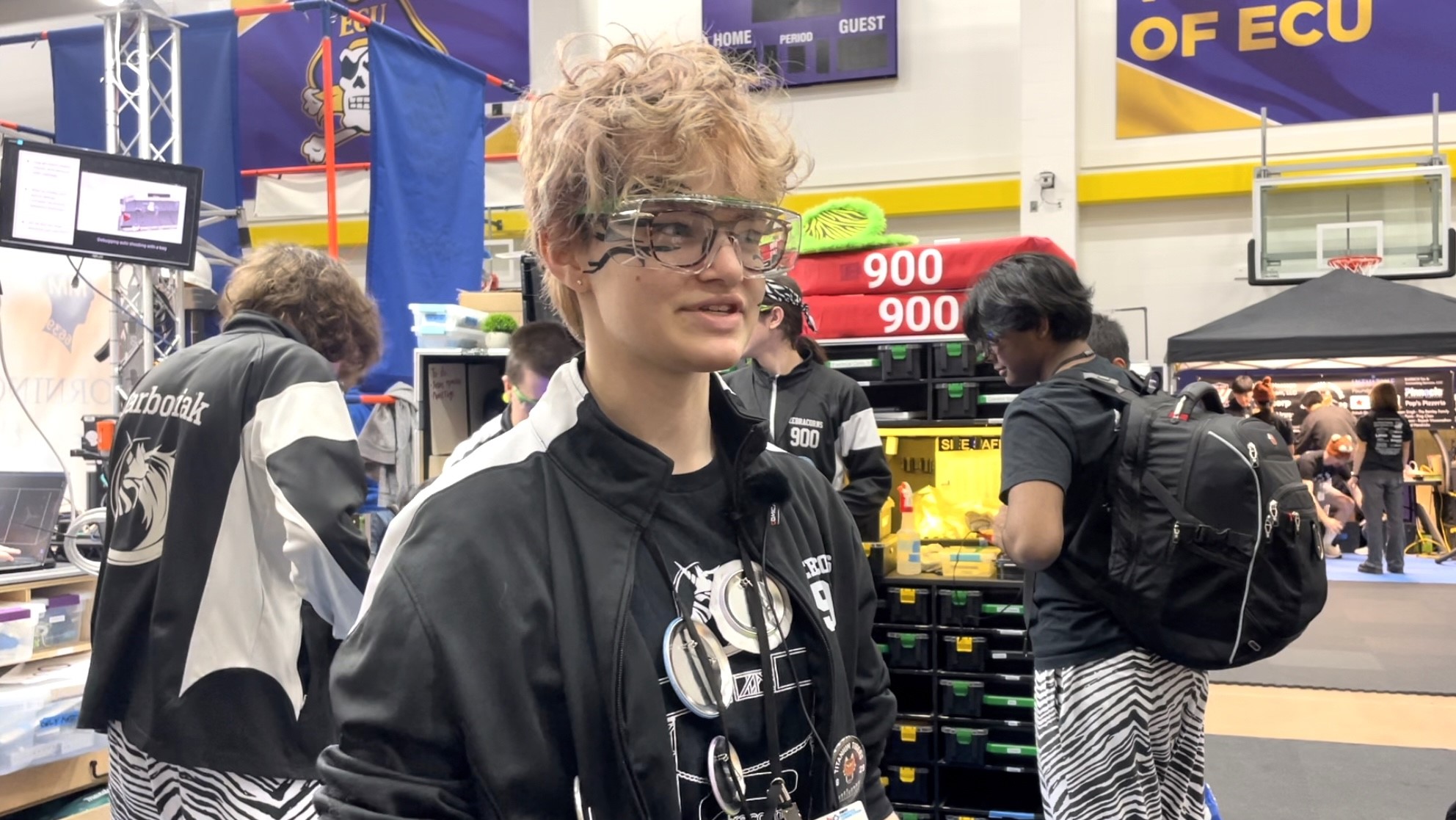
    In this broadcast, The Stentorian reporter Teresa Fang interviews Zebracorns members Robbie Stoffel ’25, Vincent Barboriak ’25, and Ketan Mummareddy (Green Level High School) ’26.

  • Zebracorns FRC 900 of NCSSM Compete at FIRST North Carolina District State Championship // Day 1

    Zebracorns FRC 900 of NCSSM Compete at FIRST North Carolina District State Championship // Day 1

    By Teresa Fang / April 6, 2024

    After winning the Impact Award at the 2024 Orange County District Event and competing at the 2024 FNC District UNC-Asheville Event, NCSSM’s FRC team, the Zebracorns, compete at the FIRST North Carolina District State Championship, held at the East Carolina University. April 6, 2024, was day 1 and included qualifiers.

    In this broadcast, The Stentorian reporter Teresa Fang interviews members Ava West ’24 and Rohit Kumar ’26 (Green Level High School) and principal coach Marshall Massengill ’05.

  • Creating “third spaces” will revolutionize the NCSSM campus

    Creating “third spaces” will revolutionize the NCSSM campus

    By Teresa Fang / February 1, 2024
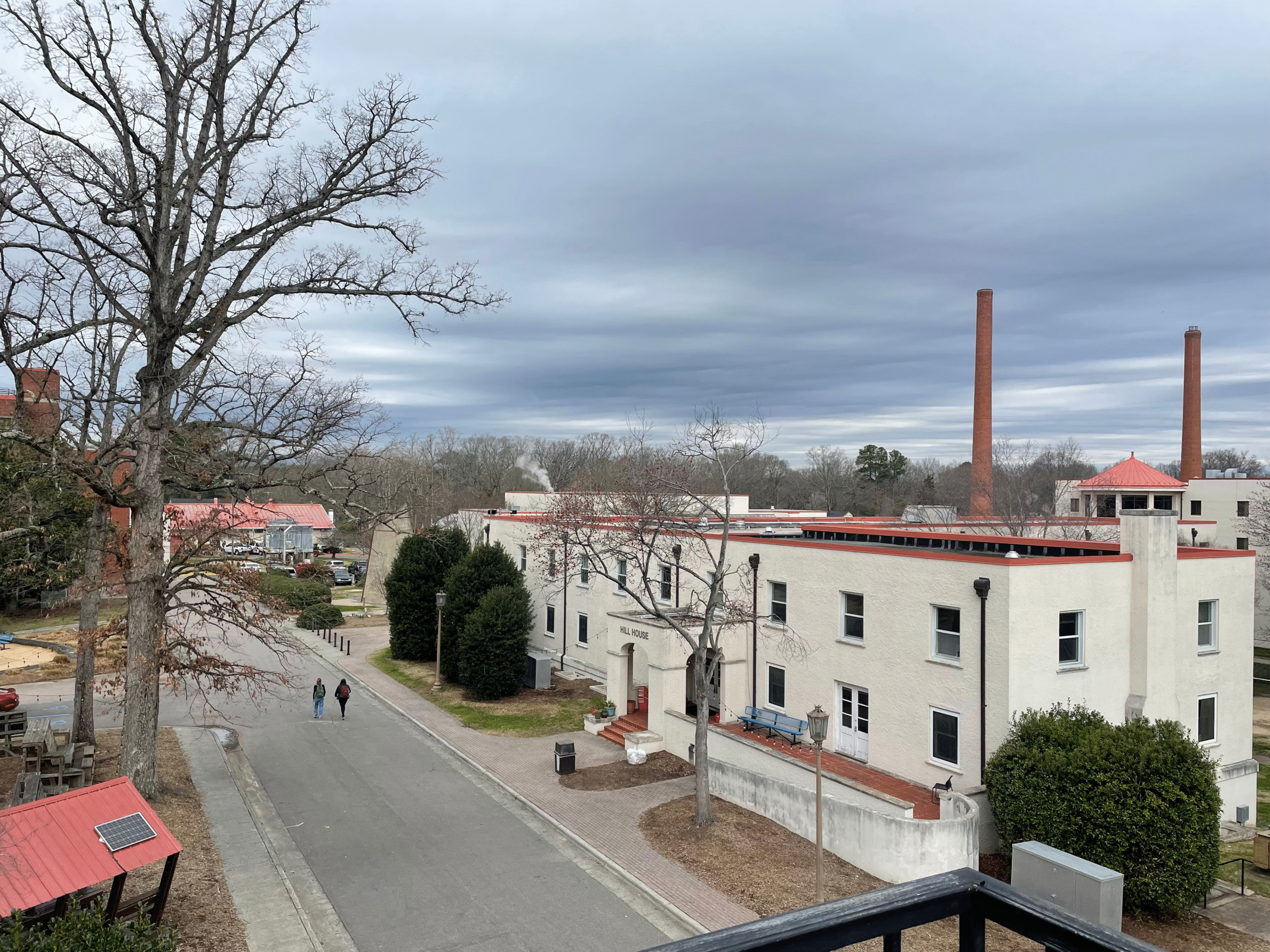
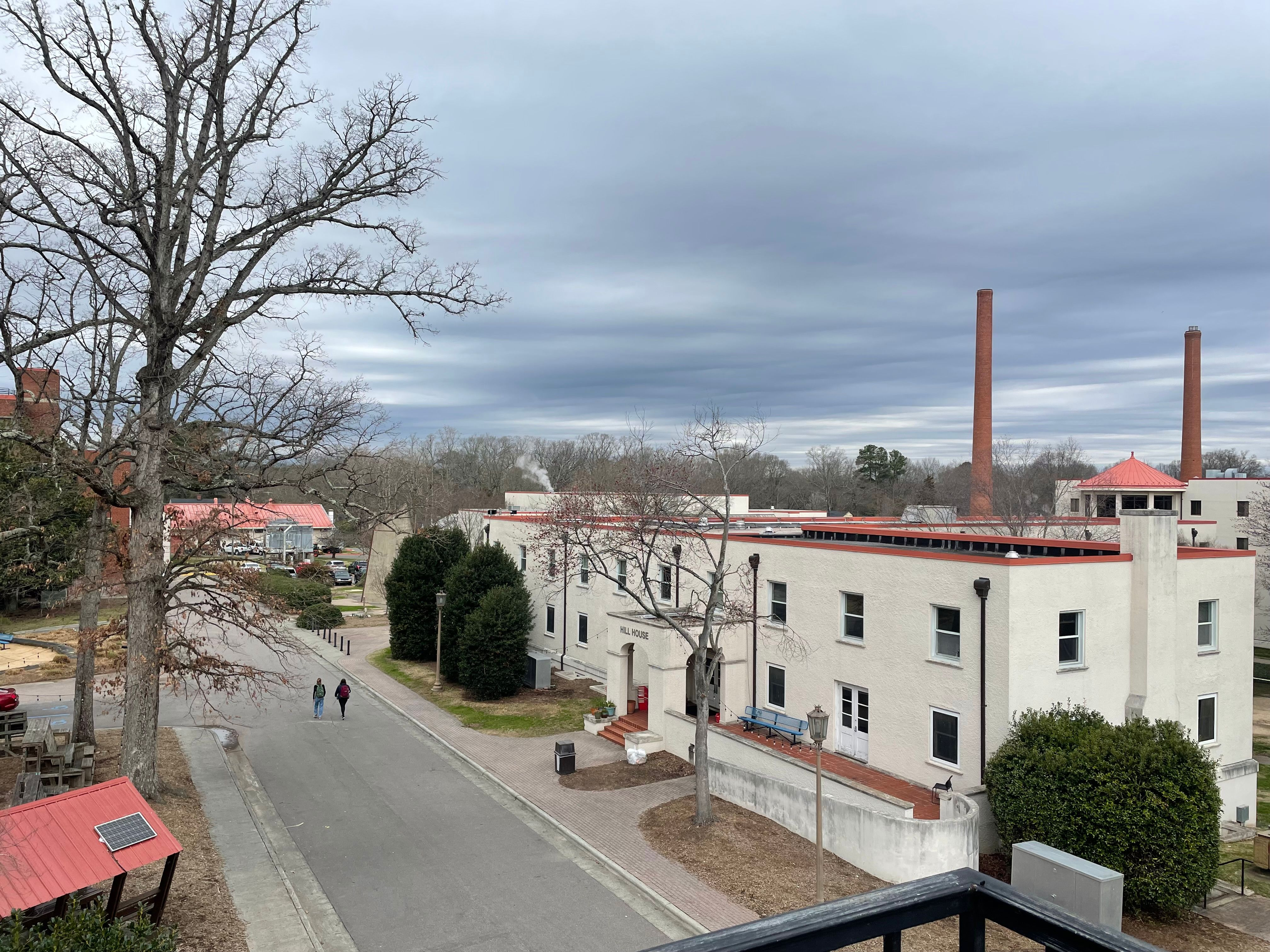
    The Hill dorms are one of the first buildings set for a complete renovation and move-out of students this summer. (Teresa Fang/Stentorian)

    Undoubtedly, an NCSSM student’s study time is one of the most important times of their day. Whether they study in their dorm room, Bryan lobby, the smelly Hill basement, or the raucous library, they’ll brave whatever conditions to get their work done. 

    The school is trying to accommodate studying spaces, but it is missing a critical perspective: students want comfortable social spaces. Administration has always been, quite rightly, concerned with the efficiency of things and places on campus. It’s why there are so many renovations: Hill residents are moving into modular trailers, a new building is in the works where the current Pit is located, and the new PEC was designed to encourage students to come study and socialize. 

    An institution would normally track its utilization rates, which refers to the amount of campus space that students actively use. NCSSM does not record this number, meaning there could be massive amounts of wasted space and the school is unaware of it. If those spaces can be prioritized for specific purposes and appeal to students, the NCSSM campus itself can be revolutionized.

    Three Dysfunctional Realms

    The goal of targeting net zero carbon proves difficult when an institution needs to create and maintain more space than it theoretically needs operationally. 

    There is a way to dramatically improve utilization rates at NCSSM: the rise of “third places.” First coined by sociologist Ray Oldenburg in 1999, the term refers to places where people spend time between home (“first place”) and work (“second place”). This “third place” refers to places for exchanging ideas, having a good time, and building relationships. Together, these three realms constitute a community’s social vitality.

    For residential students like us, the boundaries between these three realms are often blurred. Our first place (the dorm) is within our second place (the school), and we select our third place (literally anywhere at the moment). Students find both friends and passion within the school walls. But when this balance is tipped, the three realms are practically nonexistent and we potentially miss out on important spaces that could have been better effectively used.

    There is no shortage of places to study, for example, the library is plenty big enough for that. But it is not big enough to fit both the studyers and the talkers inside, creating rifts between students and librarians. This is apparent with former evening librarian Ms. Amme’s resignation on January 30. While she was doing her duty of keeping the library quiet for studying, some students were compelled to use threats for their own beliefs.

    It is a known fact among the students that people go to the library to chat, not to study. This displaces both groups of people: the studyers can’t study well, and the talkers are too busy avoiding the librarian to socialize comfortably. 

    “I think we have adequate space, but we could definitely use a few more options,” said Chris Hopkins, the assistant director of campus safety. “I have noticed during certain periods the studying locations become quite full. I hope that once the construction ends on the athletic fields and the weather warms, that area can be used for socializing, intramural sports, etc.”

    However, this construction is not planned to end until 2027. Coupled with the rise of colder weather, students literally have to brave natural conditions if they want to study outside. 

    Ultimately, there is no functional third or second space at NCSSM.

    Creating Go-to Spaces for Students

    One of the problems with erecting third spaces is that they might not be attached to a clear research or teaching function, therefore hard to justify for financial planning. However, from both educational and social standpoints, it is clear that communal social and learning spaces are incredibly important to integrate into a campus like ours – and to get right.

    In planning third spaces, even small design changes would encourage student interactions. Students need to physically meet each other in comfortable spaces that have good daylight, ventilation, temperature, acoustics, furnishing, and vibe. A variety of spaces, in particular, “living room” -type proportions, would allow for quick and easy interactions as opposed to just a large ground-floor atrium like Bryan lobby.

    By no means is this a call for more heavy construction during the academic year. Some sections of the new PFM are examples of how to go about this: students enjoy the smaller-sized spaces with some amount of privacy but also comfort.

    “I have only been here since last April, but I have noticed that with the opening of the cafeteria, students seem to congregate in the open area with couches and tables,” said Hopkins. “I also noticed students enjoy studying in places where it is quiet enough to study, but not secluded away from other students.”

    By creating more hospitable conditions for third spaces to develop and thrive, unused space in NCSSM can be transformed into regular go-to spaces for NCSSM students, where their priorities can be best taken care of. Instead of avoiding the library because of the din, students can use the space to study. Instead of being afraid of being overheard in the wide-open Bryan lobby, students can chill comfortably in an accessible cafe-like setting. Instead of ordering new buildings with big bucks, we can get more bang for smaller bucks by renovating existing places.

    Recognizing that these third spaces can revolutionize the campus can do much to help students live happier and work harder at NCSSM.

  • Knife Violence: A Prominent Issue in the United Kingdom

    Knife Violence: A Prominent Issue in the United Kingdom

    By Om Nair / May 24, 2024

    A protest against gun and knife crime in Brixton, London, in May 2024. (Peter Marshall/Alamy)

    In 2023, on a Sunday night in the midsts of North London, a gang of thugs burst into a rural chicken shop and slashed a young man with their machetes as customers (and other employees working behind the counter) fled during the attack. The young man desperately crawled under the counter, hoping to hide from the lively mob. Sadly, it was no use. The group of thugs climbed over the top and, according to an article published by The Sun, “continued their attack on him” (Duffy). After the ordeal had ended, the young man was reported staggering away, with one of his pant legs appearing to have been viciously ripped from a machete blow. When police arrived at the scene (around 9:15 PM), two men – aged 20 and 17 – were taken to the hospital to treat their stab wounds. Fortunately, neither of their injuries were life-threatening. 

    Knife violence incidents are extremely prominent in the United Kingdom, with Home Office data, in March of 2022, showing that there were “261 homicides (currently recorded) using a sharp instrument, including knives and broken bottles. This meant sharp instruments were used in 405 of the 594 homicides that occurred in 2021-22” (UK Parliament). In 2023, in the city of London alone, 21 teenagers were killed – with 18 of them passing away from brutal stabbings.

    Famous English actor and rapper Idris Elba joined protestors from the “Don’t Stop Your Future” campaign outside Parliament, dressed in clothes in shoes that are characteristic of those who have been murdered by knives. “I can’t stay silent as more young lives are lost to these brutal and heartless crimes,” Elba said. “As school returns, too many young people will not be joining their classmates and too many grieving families have lost a young person they love in recent years” (AP News).

    The term “knife crime” has started to become a common phrase used in the media, yet the very definition of this phrase has become ambiguous. Knife crime can refer to a variety of circumstances, ultimately making it difficult to define and even comprehend its popularity in our society. To put it simply, knife crime refers to any illegal act that involves the appearance of a knife. This means that scenarios ranging from sexual assault and robberies can be deemed as a “knife crime.” 

    Recently, the media (news portals, media influencers, politicians, and more) have claimed that crimes involving the use of a knife are an “epidemic” and are detrimentally influencing the younger generation. A research report posted on the National Library of Medicine’s website titled “Exploring UK Knife crime and its associated factors: A content analysis of online newspapers” provided statistics that support this notion by mentioning the emergence of stabbing instances in the United Kingdom and other neighboring countries, “Knife crime offenses in England and Wales have increased by 80% in the last five years, reaching levels not seen since 1946. Offenses involving knives or sharp instruments rose by six percent from 47,388 to 50,019 in England and Wales before the first Covid-19 lockdown was imposed… Most of the victims and the perpetrators of these crimes were Black and Asian, especially young people aged to 10 to 25” (Vinnakota, Rahman, Sathian, etc. al.). 

    Quoted from a report written by Joshua Askew and Sudesh Baniya, ‘violence is like a virus.’ As cases of knife violence continue to surge in England’s society, the sense of fear that is associated with these stabbings will become contagious. That fear is often accompanied by a strong urge for security. Pointed out by Patrick Green, Chief Executive Officer of the Ben Kinsella Trust (an anti-knife crime charity), ‘The vast majority of young people don’t carry knives. They know it is wrong. But there are some who we as a society have failed to keep safe and help make better decisions. Social exclusion, poverty, deprivation, inequality, racism – a whole number of factors make people vulnerable to being drawn into crime and, ultimately, violence. Once it becomes established, it grows quickly.” 

    But, the United Kingdom isn’t the only country that is facing these colossally high knife crime rates. In fact, knife violence is also a prodigious problem in the United States. While the majority of the homicides committed in our nation are done so with the use of a firearm, recent federal research studies have displayed that knives are the second most used weapon of choice in murder cases. 

    So, while the UK government has been heavily criticized for their inability to maintain their high knife-crime rates in their streets, it is worth mentioning that knife violence is not just a local issue on the streets of London or Manchester, but rather a global complication concerning several countries and their citizens. A write-up created by Robert Kaiser named “The Global Rise of Knife Crime” jumped into this idea by providing statistics pertaining to certain countries that have shockingly high knife crime instances, “Let me highlight just a few headlines and dates of some rather horrendous violent incidents involving edged weapons from around the world, helping us to understand that it is a global issue, not limited to a certain belief, language, culture or country… Germany: Newspapers reported about a serious increase in knife crime, telling us that ‘…more than 1,600 knife-related crimes were reported in Germany during just the first five months of 2017, an average of 300 each month, or 10 each day.’ On the 20th of July this year (2018), at least 14 people have reportedly been wounded, two of them seriously, in a knife attack on a bus in Lubeck, Germany… Israel: Only a few days ago, on the 14 November 2018, a terrorist wounded seven police officers in a stabbing attack in Jerusalem… Australia: On November 9th, 2018, a man set a car on fire and stabbed three people in Melbourne, one fatally. He died in hospital after being shot by police.”

    Knife violence is a problem that is rarely mentioned or thought about when talking about global issues. Understanding the prominence of knife crimes, not just in the United Kingdom but throughout the world as a whole, can help several communities pay more attention to the gruesome (and frequent) consequences of knife violence.

    So, the next time that you find yourself participating in a discussion regarding difficult situations happening across the world, consider shedding light on knife violence and educating your peers on this topic. By talking about knife violence (and other sensitive subjects), we can help administer change by cultivating more attention around this problem.

    Citations:

    1).https://www.euronews.com/2023/04/20/violence-is-like-a-virus-why-are-so-many-british-kids-stabbing-each-other

    2). https://www.statista.com/statistics/195325/murder-victims-in-the-us-by-weapon-used/

    3). https://www.gafirm.com/legal-blog/commonly-used-weapons-for-homicides/

    4). https://www.ppss-group.com/blog/the-global-rise-of-knife-crime-why/

  • Perspective: NCSSM Apocalypse: Scenes from Around Campus in the Wake of a Storm

    Perspective: NCSSM Apocalypse: Scenes from Around Campus in the Wake of a Storm

    By Avery Prince / September 1, 2023
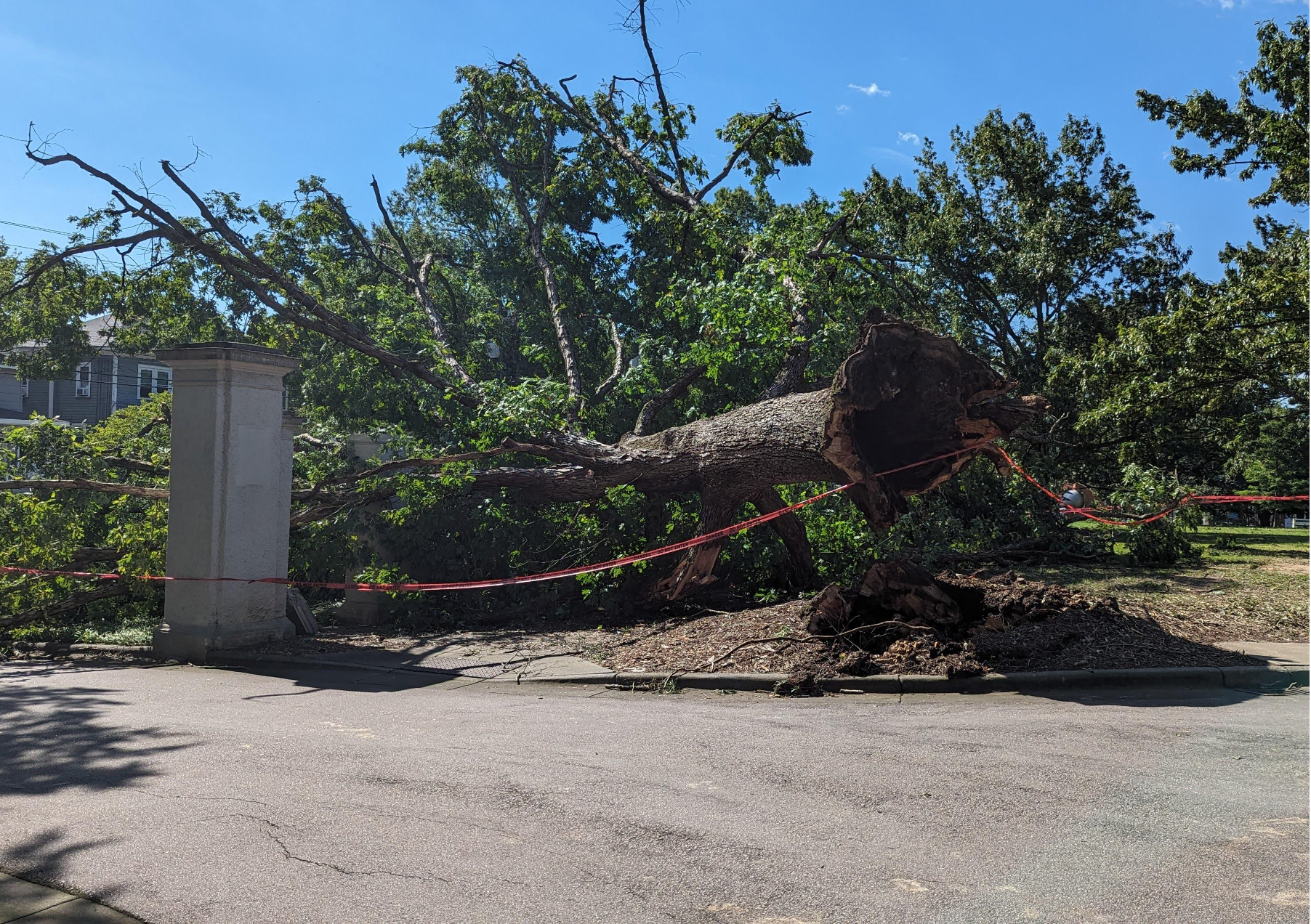
    A fallen tree lies uprooted at the entrance to Watts Circle on August 15. (Avery Prince/Stentorian)

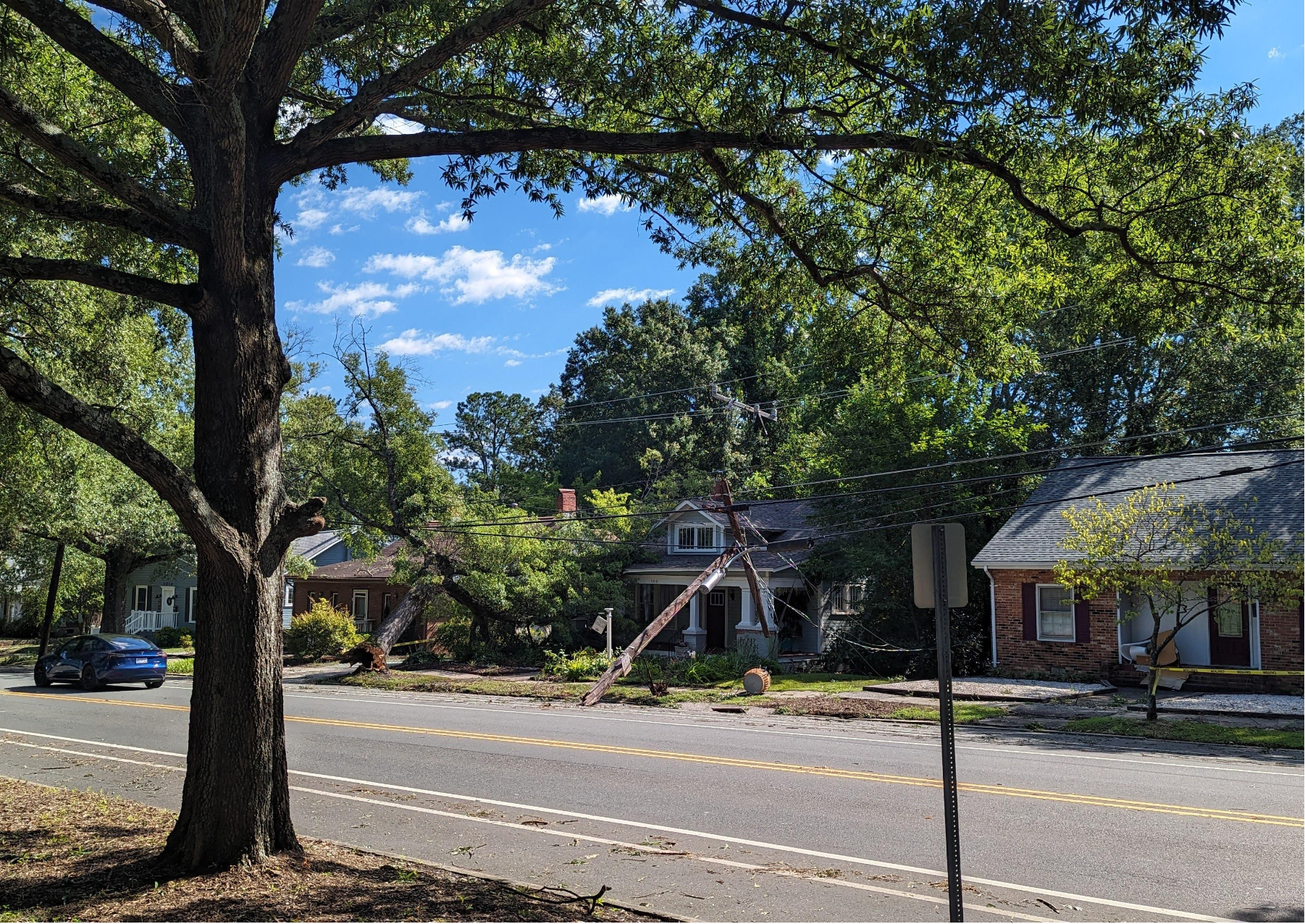
    Intense storms and winds surrounded the Triangle on August 15th, leaving fallen trees, broken power lines, and power outages across the area. Duke Energy reported over 56,000 power outages, most of which occurred in Durham County. Winds were up to 70 miles per hour, causing trees to fall and creating dangerous driving conditions that lead to multiple crashes and roadway incidents.Across NCSSM’s Durham campus there were several signs of the damage from the storm, fallen trees and broken power lines were amongst the various damage left in the wake of such an intense storm. 

    Before the chaos of this storm, students and faculty gathered in the PEC for NCSSM’s 44th convocation. For the first time in NCSSM history, convocation was centered on NCSSM’s second campus in Morganton, being broadcast over Zoom and projected in Durham. Just as the keynote speaker was about to speak, the power went out and the lights in the PEC shut. A wave of panic ran through the PEC, and faculty calmed students down, encouraging them to remain quiet and stay seated. To pass time, students shined their phone flashlights and sang together, making the most of a difficult situation. Eventually faculty helped students exit the PEC and return to their dorms, where the backup power lit the halls and the heat was intense.

    The storm on August 15 left power lines and trees nearly on top of nearby houses on Broad Street. (Avery Prince/Stentorian)

    NCSSM was faced with over 25 hours with no power. Emergency generators fired up and certain parts of campus had emergency power, covering only necessities.

    Classes were canceled, and students found ways to pass the time and cool off across campus. Bryan Lobby was popular with many students, as it allowed students to charge their various devices and cool off with fans. Many students appreciated this time as an opportunity to bond, and distracted themselves from the unpleasant conditions by spending time bonding with friends by playing card games, socializing, and cooling off together. Late in the afternoon, power returned and the usual rhythm of NCSSM resumed, but the storm had left its mark. 

    While it was not an ideal start to the year for many students, NCSSM students were able to accept this great challenge and make the most of the storm and power outage. 

  • NCSSM alumni return for Alumni Weekend 2023

    By Teresa Fang / October 23, 2023
    The newly renovated PFM. (Teresa Fang/Stentorian)

    For three days in October, Unicorns from all over the nation and world galloped to NCSSM in Durham. Nostalgia filled Bryan lobby as more than 470 NCSSM alumni returned for Alumni Weekend 2023.

    Alumni Weekend is a tradition with 41 years in the running – nearly half a century of connecting Unicorns thanks to the generosity of alumni and the up-to-the-minute NCSSM alumni network. The event plans had been in the works since last year, and thanks to the Alumni Weekend 2023 ReUNIon Committee, Team NCSSM, and the NCSSM Alumni Association, the classes of 1983,’88, ‘93, ‘98, ‘02, ‘08, ‘13, and ‘18 enjoyed a “State of the School” remark, Alumni Awards, class activities and photo slideshows, and student-led campus tours. 

    Around the World, In the Network

    When seniors graduate, they get automatically added to the NCSSM Alumni Network, which currently consists of 12,464 alumni (as of this article’s publication).

    “It’s something that we have here that I think makes us truly special. Any school could have a database, but it’s hard to have the discipline and the persistence to do it over time,” said Brock Winslow, ‘86, the vice chancellor for external relations and chief of staff since 2007. The database traces back to the first graduated class of 1982.

    While the Alumni Association’s Alumni Network is a self-updating network, the contact information is ultimately gathered to organize the Alumni Weekend. The event started on Friday with a Zoom meeting where more than 300 people would join from around the world.

    “Literally, you could see people log in from Singapore. Around the world, you just name it.” Winslow said. “When alumni go to our Facebook page, they can watch this, see the [ReUNIon Committee] officers, get the ‘State of the School’ address, and more.” According to the Alumni Association, about 20 percent of all NCSSM alumni attend the meeting or watch its recording.

    “What I loved the most? I think it was the community of nerds.”

    When a student starts their “flight” at NCSSM, they join hundreds of students like them but are from all areas of North Carolina. Regardless of whether it was connecting with the students and teachers, or taking in the advantages and opportunities, alumni owe their post-high-school lives to their alma mater.

    “Being here definitely grew my network, and helped me grow into myself as a person,” said Maya Mims, ‘18, who is now a math teacher in Washington, D.C. Surprisingly, prior to NCSSM, they hated math. Their classmates and teachers, especially Dr. Dan Teague, helped turn that attitude around. “They definitely helped spark a lot of my love for teaching, math, and academia, so that’s why I’m teaching now.”

    Other alumni made lifelong friends and memories. On Alumni Weekend, many current students noted there were many couples and families present. For example, although Gabriel “Gabe” Whaley and Amy Kim, both ‘08, never dated in high school, they recently got married.

    Whaley, the class of 2008 student body president, is now the CEO and founder of MSCHF, a viral art collective. Despite his laments over the amount of work to do as a president, Whaley enjoyed having fun and connecting with the people at NCSSM, especially his cabinet. 

    “What I loved the most? I think it was the community of nerds. I felt like this was a great place to be myself and grow, other than doing things I should have gotten in trouble for…” He said, keeping his detailed mischiefs off the record. Behind him, his vice president Andrew Ngo quipped that one such deed included copying master keys and distributing them to seniors.

    For Catherine Kirby Dunleavy, ‘88,  she treasured her friendships: “I always felt like [NCSSM] was just the most accepting place I’ve ever been in my entire life.”

    At the time of the interview, she was walking with a group of same-class alumni, the oldest friendship of which was with David Steinmiller, ‘88, when the two met while Dunleavy was reading a magazine in the ETC courtyard before the first day of school. 

    “We were just looking at the [alumni class] slideshows, and I remembered all the activities and cultural stuff we did, not just math and science,” Steinmiller said. “I don’t think you could recreate this like in fancy private schools, because those people aren’t drawn there. NCSSM are the dorks of North Carolina – and that’s the best thing. There’s nothing quite like this, really.”